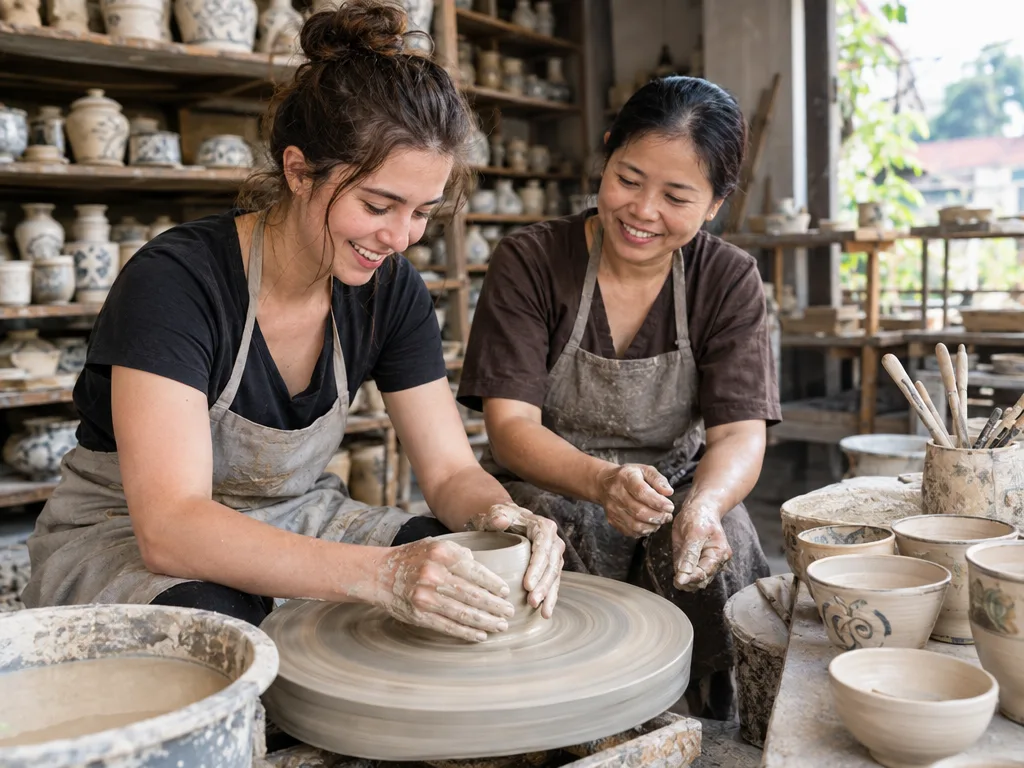
Bat Trang is one of the most rewarding cultural day trips from Hanoi when you treat it as a living craft village rather than a quick shopping stop. The visit works best when you leave room for a hands-on activity, a slower walk through the village, and time to notice how pottery fits into local life. This workshop-first plan is designed for travelers who want a practical Bat Trang pottery village day trip from Hanoi without trying to force every possible stop into a single outing.
What makes Bat Trang worth a day trip?
Bat Trang is in Hanoi’s Red River Delta and is widely associated with pottery and porcelain. The village’s identity is not only historical. Local reporting continues to describe pottery as an important traditional craft, with makers and businesses balancing inherited techniques, product development, branding, training, and changing customer expectations. That combination gives the visit more depth than a conventional attraction: you are seeing a working craft community adapting while preserving its character.
Historical accounts place Bat Trang’s pottery tradition many centuries back, with references to the village as a ceramics-producing community by the medieval period. You do not need to turn a day trip into a history lecture, but this background changes the way you read the lanes, workshops, displays, and finished pieces. A bowl is not just a souvenir; it is the visible result of clay preparation, shaping, decoration, firing, quality control, and a long chain of local knowledge.
The strongest search intent for this trip is practical: visitors want to know what to do, how to structure the visit, what to expect from a pottery workshop, and how much time to allow. The answer is to plan around one central experience and use the remaining time for context, browsing, and a relaxed meal or coffee break rather than collecting an exhausting list of attractions.
Choose your main experience before you leave Hanoi
A clear priority makes Bat Trang easier to enjoy. Pick one of these approaches, then let the rest of the day support it.
- Make-and-paint visit: Choose this if you want an activity you can remember and talk about later. Expect the process to be hands-on and accept that your finished piece may look more personal than perfect.
- Craft and heritage visit: Focus on village streets, older architectural details, displays, and the story of the trade. This suits travelers who prefer observation to making an object.
- Shopping with context: Browse after learning a little about production. You will have a better basis for comparing shapes, glazes, decoration, weight, and practical use.
- Family learning trip: Keep the activity central, shorten the walking sections, and allow children to ask questions. A simple making task can hold attention better than a long sequence of look-and-don’t-touch stops.
These approaches can overlap, but choosing one as the day’s anchor prevents the common mistake of spending the first half of the visit browsing and then rushing the workshop. If your group has mixed interests, agree that everyone will share one main activity before splitting briefly for browsing or photography.
A workshop-first itinerary for Bat Trang
1. Start with orientation, not shopping
Once you arrive, take a few minutes to understand the layout and decide where the day’s main activity fits. Look for a workshop or visitor experience that explains what participants will do, what is included, and whether the finished item is taken immediately or handled later. Because offerings can change, confirm the current process directly rather than relying on an old itinerary or a remembered price.
Beginning with orientation also helps you notice the difference between a retail showroom and a place where pottery is actually made. Ask polite questions about the stages you can observe. If a space is busy or production is underway, follow the staff’s instructions and keep clear of working areas.
2. Put the hands-on activity in the middle of the visit
A making session is often the most memorable part of a Bat Trang day trip, but it is easier to enjoy after the group has settled in. Use the activity as the middle anchor: arrive with enough energy to concentrate, then allow time afterward for the object to be checked, packed, collected, or otherwise explained. Do not build a tight onward schedule around an item whose handling arrangements you have not confirmed.
For children, the value is not artistic perfection. The useful lesson is that a familiar household object passes through several stages before it becomes a finished piece. For adults, the activity offers a better appreciation of variation in handmade work. Small differences in shape or surface are part of the experience, not necessarily defects.
3. Walk slowly after the workshop
After the activity, take a quieter route through the village. Notice storefronts, courtyards, workshop entrances, signs, displays, and the way residential life sits alongside trade. Keep photography considerate, especially where people are working or where a lane functions as someone’s home rather than as a public exhibit.
4. Browse with a purpose
Return to the shops after you understand more about the craft. Compare pieces by intended use instead of choosing only by color. Ask whether an item is designed for food, display, gifting, or everyday household use, and check how it should be carried. If you are buying several pieces, group them carefully and leave enough space for protective packing. A lighter purchase that travels safely is usually better than an ambitious haul that becomes difficult to manage.
How much time should you allow?
For many travelers, a half-day can cover one workshop, a short village walk, and focused browsing. A fuller day is more comfortable if you are traveling with children, want a slower pace, need time for a meal, or prefer to compare several makers. The right length depends less on the number of attractions than on how much time your group needs to move between making, observing, shopping, and resting.
Use these planning questions rather than copying a rigid timetable:
- Does everyone want to join the same pottery activity?
- Will children or older travelers need regular sitting breaks?
- Are you carrying fragile purchases back to Hanoi?
- Do you want a cultural visit, a shopping visit, or both?
- Can your return journey remain flexible if the workshop or traffic takes longer than expected?
As a general planning principle, keep the first and last parts of the day less crowded. A delayed departure or a longer packing process is much less stressful when you have not promised a chain of fixed appointments afterward. Treat travel duration as an estimate, especially when road conditions, weather, or your starting point vary.
Getting there without making the day harder
Bat Trang is close enough to Hanoi to work as a manageable excursion, but “nearby” does not mean that every route will take the same time. Before leaving, check the route from your actual hotel or neighborhood, the vehicle space available for purchases, and the return plan. A private car or taxi may be simplest for groups carrying ceramics, while public transport can suit travelers who prefer a lower-cost and more independent outing. Confirm the latest route information on the day because transport arrangements and road conditions can change.
If you are booking a tour, ask practical questions before paying: Is the pottery activity included or optional? Is the guide accompanying the group inside the workshop? How much unstructured time is available? What happens if a piece needs later collection or special packing? Clear answers matter more than a long list of advertised stops.
When traveling independently, save the name and location of your chosen workshop or meeting point, but keep a backup plan. If a venue is crowded, closed for a private event, or not suitable for your group, the day should still work as a village-and-craft visit rather than collapse around one booking.
Buying pottery responsibly and safely
Shopping is part of the experience, but responsible buying starts with realistic expectations. Ask about the piece’s intended use, care instructions, and packing. For tableware or cooking items, request guidance from the seller rather than assuming that every decorative ceramic is suitable for food or heat. If the item is a gift, confirm the best way to protect it during transport.
Support the craft community by paying attention to the people behind the objects. A respectful purchase does not require bargaining over every small amount, especially when a maker or family business has spent time producing a handmade piece. Look for workmanship you genuinely value, buy only what you can carry safely, and avoid treating active workshops as photo sets.
The local authority’s recent discussion of Bat Trang’s craft sector highlights pressures that include competition, changing designs, training the next generation, branding, logistics, and links between production and tourism. That context suggests a useful visitor habit: choose experiences and products that help you understand the living craft rather than reducing the village to a market.
What to pack for a comfortable visit
- Comfortable shoes for uneven lanes and standing during a workshop.
- Water and sun protection, with a light layer for changing weather.
- A small bag with room for secure packing, rather than an overfilled daypack.
- Hand wipes or tissues for clay and workshop surfaces.
- A phone power bank if you are using maps, translation, and payment apps.
- Space in your schedule for a break, especially on a hot or busy day.
Wear clothing you can move in and do not choose an outfit you would be upset to mark with clay. Ask before touching tools, shelves, or unfinished pieces. If your group includes a traveler with limited mobility, discuss the walking surface and workshop access in advance instead of assuming that every lane or studio is equally easy to navigate.
Common planning mistakes to avoid
The first mistake is treating Bat Trang as a single shop. The village makes more sense when you combine one practical activity with observation and conversation. The second is trying to visit too many places without leaving time for the workshop. The third is assuming that online descriptions of schedules, prices, or inclusions are still current. Verify those details directly.
Another mistake is buying first and asking questions later. Learn how an object is used and packed before committing to it. Finally, avoid photographing people, homes, or production areas without permission. A living village deserves the same courtesy you would show in any neighborhood where people work and live every day.
Is Bat Trang right for your Hanoi itinerary?
Choose Bat Trang if you want a nearby cultural outing with a tangible activity, a strong craft identity, and room to set your own pace. It is especially suitable for travelers who enjoy making, browsing useful objects, meeting local makers, or seeing how a traditional industry continues to adapt. It may be less satisfying if your priority is a dramatic landscape, a tightly scripted sightseeing checklist, or a destination where every stop is designed exclusively for visitors.
The best version of the trip is deliberately modest: one well-chosen workshop, a thoughtful walk, careful browsing, and enough flexibility to notice what is happening around you. Plan for the experience rather than the souvenir, and Bat Trang can become one of the most memorable day trips from Hanoi.
JOIN THE CONVERSATION
Comments (0)
No comments yet. Be the first to share a thought.