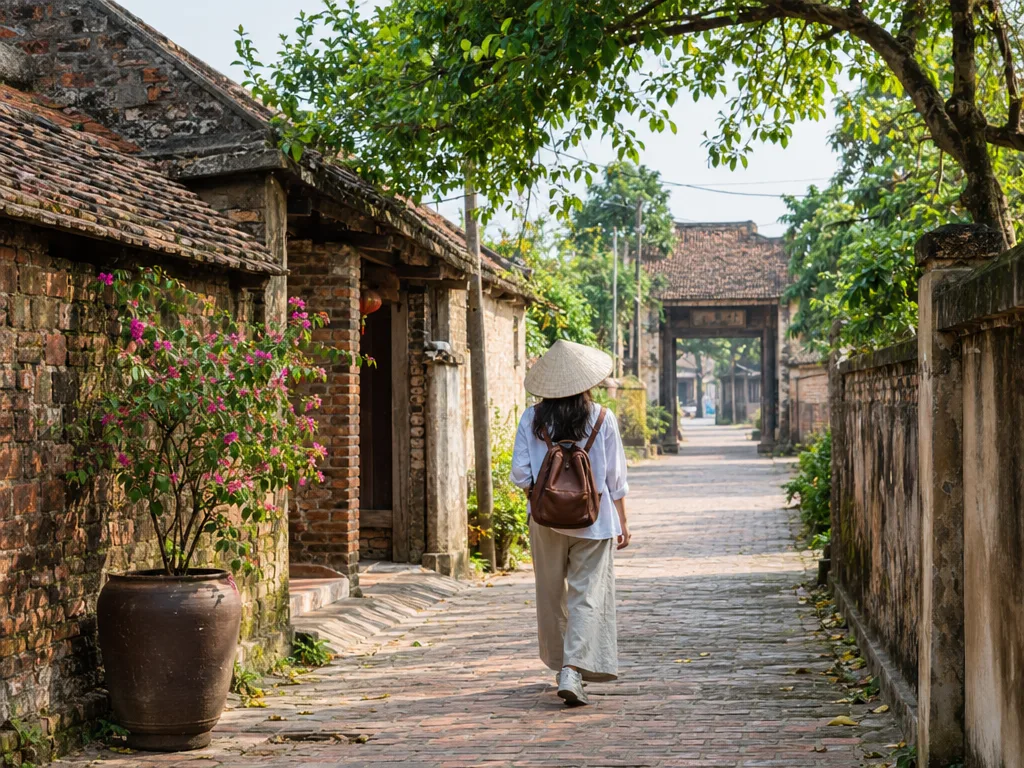
Duong Lam Ancient Village is best experienced on foot, slowly enough to notice the laterite walls, village gates, communal spaces, old wells, and everyday life around them. If you are searching for a Duong Lam walking route from Hanoi, the aim is not to collect every monument in one morning. It is to create a gentle loop through a living heritage landscape, pause respectfully, and leave time for a meal or conversation before returning.
Why choose a walking-focused Duong Lam visit?
Many Duong Lam day trips are described as a list of stops, but the village makes more sense as a connected place. Its lanes, houses, ponds, shrines, communal buildings, and agricultural edges form a cultural landscape rather than a single attraction. Walking lets you see the transition between public heritage and private homes, and it helps you notice details that disappear when a vehicle moves from gate to gate.
Duong Lam is associated with the historical figures Phùng Hưng and Ngô Quyền, and the area is known for traditional village architecture built with local laterite and mud. The Vietnamese Ministry of Culture and Information recognised it as a national historical-cultural relic in 2006. Those facts matter, but they should not turn the visit into a rushed checklist. The strongest experience comes from combining a few meaningful heritage stops with unstructured time in the lanes.
- Choose walking if you enjoy architecture, photography, local food, and quiet observation.
- Expect uneven surfaces, heat, shade changes, and occasional traffic on shared village roads.
- Think of homes and working spaces as part of a community, not as open-air museum exhibits.
How to structure a relaxed Duong Lam walking route
A practical route has three parts: an arrival point, a heritage core, and a slower outer section. The exact order can change according to weather, local access, and how much time you have. Use the following sequence as a planning framework rather than a fixed timetable.
1. Begin at the village entrance
Start by orienting yourself near the entrance and checking where your group can leave a vehicle or meet a guide. Take a few minutes to understand the lane layout before walking deeper into the village. This is also a good moment to agree on a meeting point, especially if some travellers will explore more slowly than others.
2. Follow the lanes toward Mông Phụ
Mông Phụ is the natural heart of a first visit because its entrance, communal house, lanes, and traditional homes create a compact introduction to Duong Lam. Walk at a pace that allows you to stop without blocking residents or other visitors. Look for relationships between the lane, courtyard, wall, doorway, and water features rather than treating each building as an isolated photo stop.
3. Add one or two heritage detours
After the central lanes, choose a small number of supporting stops. Mia Pagoda, Phùng Hưng Temple, and Ngô Quyền Temple are often included in wider Duong Lam itineraries, but the right choice depends on your energy and interests. A walking-focused day is more rewarding when you select two or three places and visit them attentively instead of attempting every possible site.
4. Finish with a village-edge pause
Before returning, move toward a quieter edge of the settlement or a less crowded lane. This gives you a chance to see how the historic core connects with fields, ponds, and ordinary daily activity. Keep the final section flexible: it may become a short rest, a meal, a drink, or simply time to review photographs and impressions.
What to look for in Duong Lam’s built heritage
The visual character of Duong Lam comes from small details repeated across the landscape. Laterite appears in walls, gates, wells, and other structures; traditional houses use timber, courtyards, and raised thresholds to respond to the local climate. These features are easy to miss if you only search for the most famous building.
At Mông Phụ Communal House, pay attention to the way a communal building relates to the open space around it. The communal house is not only an architectural object; it is part of village memory and community life. Observe from public areas, follow any posted or spoken instructions, and avoid turning ceremonies or residents’ activities into a performance for the camera.
Village gates and wells are equally useful for understanding the settlement. A gate marks a transition between the road and the village interior. A shared well shows how water, neighbourhood identity, and daily routines once fitted together. Old houses reveal another layer: the arrangement of spans, timber details, courtyards, and storage areas can tell you more about domestic life than a single decorative feature.
A simple observation checklist
- How does the lane narrow, widen, or change direction near a communal space?
- Where do laterite walls meet newer repairs or modern utilities?
- Which parts of a house are clearly private, and where is a visitor invited to pause?
- How do shade, trees, ponds, and courtyards affect the walking experience?
- What signs show that the village is still lived in and economically active?
Visiting temples, pagodas, and communal spaces respectfully
Duong Lam contains religious and commemorative sites as well as homes. Dress in a way that is comfortable for walking but considerate at temples and pagodas. Keep voices low, observe whether photography is permitted, and do not touch altars, statues, offerings, or architectural details. If a local ceremony or family activity is taking place, give it space rather than trying to get closer.
At Mia Pagoda, treat the visit as a spiritual and cultural stop, not simply as an indoor photo location. Pause before taking pictures and look for any instructions at the entrance. At temples linked with Phùng Hưng or Ngô Quyền, remember that commemoration remains important to local people. A respectful visit may be shorter than an enthusiastic one, but it will usually be more meaningful.
When entering a traditional home or visiting a family-run space, ask before photographing people, rooms, animals, or personal belongings. If a resident offers an explanation, listen rather than interrupting with a long list of questions. Buying a local product or accepting a meal can be appropriate when offered, but it should never be assumed that every house is open for tourism.
Food and breaks on a walking day
Walking in a rural village can feel gentle while still becoming tiring in warm or humid weather. Plan a real pause rather than treating lunch as something to fit between monuments. Look for a locally prepared meal or a small place recommended by a trusted host, and confirm what is available before promising a particular dish to your group. Menus, opening times, and availability can change, so keep your plan flexible.
Bring water and allow time to sit. A break under shade can improve the second half of the route more than adding another distant stop. If you are travelling with children or older relatives, make the meal or rest point the anchor of the day and build the walking route around it.
Do not leave packaging in lanes, courtyards, or near wells. Avoid taking food into sacred interiors unless it is clearly permitted. Small choices—refilling a bottle, carrying rubbish until you find a bin, and buying from local businesses when suitable—help reduce the pressure that day visitors place on a living village.
Transport planning from Hanoi without overloading the day
Duong Lam is west of Hanoi in the Sơn Tây area, and the journey is long enough that your transport choice shapes the experience. A private car or taxi can make the day easier for groups with limited time or mobility, while a public-transport combination may suit independent travellers who enjoy a slower, less structured outing. The best option depends on your starting point, traffic, weather, and whether you want a guide.
Rather than relying on a promised travel duration, ask the driver or operator how the route will work on your chosen day. Confirm the return meeting point, whether waiting time is included, and what happens if you decide to walk farther than planned. If you are hiring a vehicle, keep the phone number of the driver and carry the destination name in Vietnamese: Làng cổ Đường Lâm.
Do not combine Duong Lam with too many far-away attractions simply because they appear on a map. A village walking route needs margin for wrong turns, photographs, meals, and unexpected community activity. If you want a second stop, choose one that fits naturally in the Sơn Tây area and leave a clear return buffer.
What to pack for a Duong Lam walking route
- Comfortable shoes with grip for uneven lanes and worn paving.
- Water, sun protection, and a light layer for changing weather.
- A small bag for rubbish and a portable charger for navigation.
- Modest clothing that works for religious sites and hot conditions.
- Cash in small denominations, while keeping valuables discreet.
- A translation app or a few Vietnamese phrases for permission and thanks.
Rain can change the character of the lanes quickly, so a compact waterproof layer is more useful than a rigid schedule. In bright weather, a hat and breathable clothing will make it easier to slow down. If the route includes steps, rough ground, or a longer walk between sites, be honest about the ability of everyone in your group before setting out.
How to be a good guest in a living heritage village
Duong Lam’s value is not only its old buildings. People still live, work, worship, repair, cook, trade, and move through the village. Keep vehicles and voices under control, do not enter closed lanes or yards, and avoid blocking doorways. Ask permission before photographing people. When a sign, host, or resident asks visitors not to do something, follow that request without debate.
Travel slowly enough to notice where tourism ends and ordinary life begins. A good visit leaves the lanes usable, the homes private, and the heritage sites treated with care. It also leaves you with a clearer understanding of why preservation is difficult: old materials need maintenance, modern services must be added, and tourism has to coexist with residents’ routines.
A realistic one-day plan
For a calm day, leave Hanoi with enough time for traffic variation, arrive in Duong Lam before the hottest part of the afternoon, and begin with orientation rather than an immediate sprint to the most photographed gate. Spend the first walking section around Mông Phụ, pause for a drink or meal, then choose a small number of heritage detours. Use the final part of the visit for a quieter lane, a local purchase, or a conversation with your host before meeting your driver.
If your group is energetic, extend the route gradually. If the weather turns difficult, shorten the outer section and keep the heritage core. The route is successful when everyone returns curious and comfortable, not when every point on a map has been checked.
Final advice for a better Duong Lam visit
A Duong Lam Ancient Village walking route works best when it balances structure and openness. Plan your arrival, meeting point, main heritage area, meal, and return, but leave space for the details that cannot be scheduled: a shaded courtyard, a laterite wall, a quiet temple, or an explanation from someone who lives there. Keep precise opening hours, access conditions, and transport arrangements flexible until you confirm them locally. Most importantly, visit as a guest in a living community. That approach makes the day calmer, more respectful, and more memorable.
JOIN THE CONVERSATION
Comments (0)
No comments yet. Be the first to share a thought.