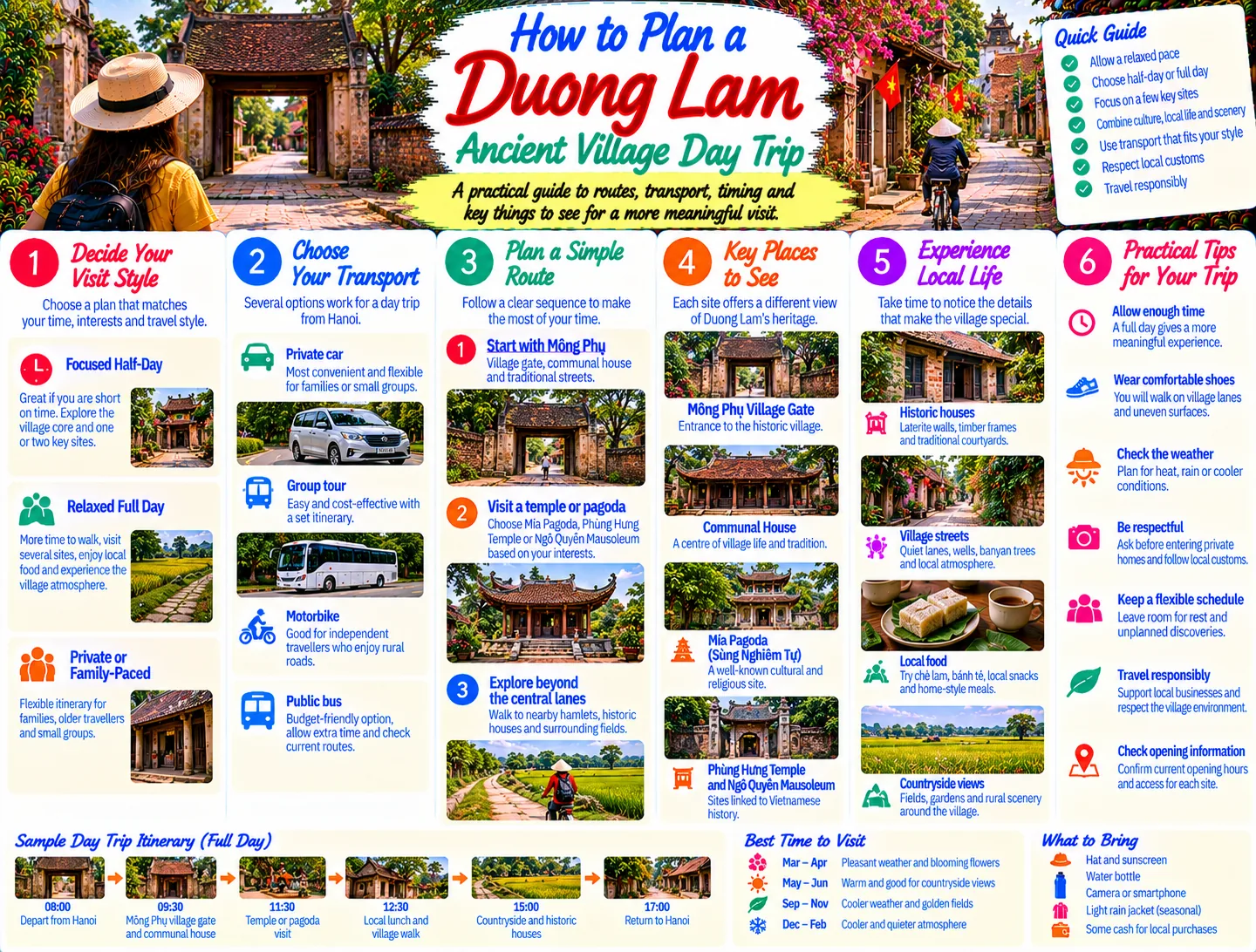
Duong Lam ancient village is best visited as a slow countryside day trip rather than a checklist of monuments. The destination is a cluster of historic villages in Son Tay, west of Hanoi, where lanes, houses, communal spaces, temples, fields and family life still form one connected landscape. A good plan leaves time to walk, pause and notice how the village works.
This guide focuses on the decisions that make a Duong Lam day trip from Hanoi more rewarding: how to shape the route, what to look for, how long to stay, what to ask before entering a home or religious site, and how to choose transport that suits your day. If you are comparing several Hanoi excursions, start with this practical guide to comparing day trips from Hanoi, then use the advice below to decide whether Duong Lam matches your travel style.
Why Duong Lam works as a Hanoi countryside day trip
Duong Lam offers a different rhythm from Hanoi’s urban attractions. The area is associated with the Red River Delta village tradition: a village gate, communal house, wells, ponds, shade trees, pagodas, shrines and cultivated land are not isolated attractions but parts of a settlement pattern. The historic core is also known for laterite construction, a material that gives many walls and houses their warm, weathered colour.
The destination has national historical and cultural relic status, and it is often described as the “land of two kings” because Phùng Hưng and Ngô Quyền are associated with the area. Those stories are one reason visitors come, but the strongest experience is usually more ordinary and more visual: a quiet lane, a courtyard, a tiled roof, a family making food, or the transition from built-up village to open fields.
That mix makes Duong Lam suitable for travellers who want cultural depth without committing to a long multi-day journey. It also suits visitors who prefer a flexible walk to a tightly timed attraction schedule. For a broader countryside perspective, you can pair this article with the guide to an unhurried countryside escape from Hanoi.
Choose the right shape for your visit
A focused half-day
A half-day can work if your priority is the historic village core. Concentrate on Mông Phụ, the village gate and communal house, then add one or two nearby heritage stops. This version is easier to fit around another Hanoi plan, but it leaves less room for unplanned conversations, food or a longer walk between hamlets.
A relaxed full day
A full day is the better choice if you want the place to feel like a living village rather than an outdoor museum. You can walk more slowly, stop for a local snack or meal, visit several religious and historical sites, and allow time for the countryside edges. A full day also gives you a buffer if traffic makes the outward or return journey slower than expected.
A private or family-paced day
Families, older travellers and small groups often benefit from a private itinerary because the day can be adjusted around walking speed, heat and rest breaks. It is still worth keeping the route modest. More stops do not automatically create a better heritage visit. If you are deciding whether a private arrangement is useful, compare your needs with this guide to when a private day tour makes sense.
Build a simple route through the heritage landscape
Rather than plotting every possible sight, organise the day into three layers. Begin with the village core, continue with one or two historical or religious sites, and finish with a quieter walk or meal. This gives the day a narrative: understand the settlement, explore its cultural landmarks, then experience its present-day atmosphere.
1. Start with Mông Phụ
Mông Phụ is a natural starting point because its gate, communal house and traditional streets make the village structure easy to read. Walk slowly enough to notice the relationship between public and private space. The communal house is not simply a photogenic building; it represents the shared life of the village. Observe the setting, rooflines, courtyards and approach rather than treating the stop as a quick photograph.
2. Add a temple or pagoda
Mía Pagoda, also known as Sùng Nghiêm Tự, is one of the area’s recognised cultural sites. Phùng Hưng Temple and the Ngô Quyền Mausoleum connect the landscape to the historical figures most associated with Duong Lam. Choose based on your interests and the time available. One meaningful visit is better than rushing through every name on a map.
3. Walk beyond the central lanes
Leave room for the edges of the settlement. Historic houses and village lanes are important, but the surrounding fields and rural views explain why Duong Lam feels different from a preserved urban quarter. The transition between houses, gardens, water and farmland is part of the destination’s character.
What to notice in the houses and streets
Duong Lam is known for historic houses built with timber frames and laterite blocks. The materials are only the starting point. Look at how the houses sit behind gates, how courtyards create distance from the lane, and how shade, walls and roof overhangs shape the experience of moving through the village. These details help you understand why a short walk can be more revealing than a list of formal sights.
The village’s layout also rewards attention. Routes around communal spaces, lanes that narrow and widen, wells, banyan trees and small gathering points make the settlement legible as a community rather than a collection of old façades. If a house is open to visitors, wait for an invitation or follow the host’s guidance. A doorway can be part of someone’s home, not a public exhibit.
Photography is easiest when you treat people and buildings with equal consideration. Ask before photographing residents, working areas or family altars. Avoid blocking lanes, leaning on old walls or entering courtyards without permission. These habits are simple, but they make a major difference in a living heritage village.
Plan transport without overcomplicating the day
Duong Lam is far enough from central Hanoi that transport affects how much of the destination you can enjoy. A private car or organised day tour is useful when you want a predictable start, direct travel and flexibility between sites. It can also be the most comfortable option for families or travellers who do not want to spend the day managing transfers.
Independent travellers may prefer a public-transport or ride-hailing combination, but should research the final connection carefully before leaving. The last part of a countryside journey can be less straightforward than the city-to-city portion. Confirm the drop-off point, return plan and approximate travel time with your driver or operator rather than assuming that a map pin tells the whole story.
Whichever option you choose, avoid packing the day with a second distant attraction. Duong Lam is most enjoyable when the schedule has breathing room. For an independent comparison of pacing, distance and transport trade-offs across destinations, see Day Trip Planning & Comparisons.
Food, breaks and small purchases
Food is part of the village experience, but it should be approached with the same patience as the architecture. Duong Lam is associated with local sweets and soy-based products, and visitors may encounter home-style food or small offerings during a walk. Treat these as opportunities to taste and learn, not as guarantees that every stop will be open or serving a particular dish.
Plan a real break rather than trying to eat while walking. A shaded courtyard, a quiet local restaurant or a host’s recommended stop can give the day a useful pause. If you have allergies or dietary restrictions, explain them clearly and ask what ingredients and preparation methods are used before ordering. Availability can vary, so a small amount of flexibility is sensible.
For shopping, choose only what you can identify and carry comfortably. Locally made sweets, sauces or small craft items may be meaningful souvenirs when bought directly and respectfully. Ask about packaging and storage if you are taking food onward in your trip, and do not feel pressure to purchase from a private home.
Visit respectfully: Duong Lam is a living village
The most important planning principle is to remember that Duong Lam is lived in. Residents use the lanes, houses and religious spaces every day. Keep voices low near homes and worship sites, dress appropriately for temples and pagodas, and follow any posted or spoken instructions. A guide can help explain what is appropriate, but visitors still need to pay attention to the place itself.
Ask before entering a home, courtyard or private workshop.
Ask before photographing people, household objects or ceremonies.
Do not climb on walls, gates, monuments or historic structures.
Keep rubbish with you until you find a suitable bin.
Give pedestrians, bicycles, animals and working residents space on narrow lanes.
Buy or eat locally only when the arrangement is clear and comfortable for both sides.
These choices are not extra rules added to the trip; they are part of understanding the destination. The earlier published article about visiting Duong Lam with care provides a useful companion read if responsible heritage travel is your main concern.
Match the day to weather, mobility and energy
Most of the experience is outdoors, with walking on uneven or narrow surfaces and periods of limited shade. Check the forecast before you leave and bring water, sun protection and footwear that feels secure. In hotter conditions, an earlier start and a longer midday break can make the route much more comfortable. On a cooler day, you may be able to extend the walk into the surrounding countryside.
Travellers with limited mobility should discuss the route in advance rather than relying on a generic promise that a vehicle can reach every sight. Ask about walking distances, surfaces, steps, toilet access and where the vehicle can wait. A realistic route with fewer stops is usually more enjoyable than an ambitious itinerary that becomes tiring.
Families should set expectations before arrival. Children may enjoy lanes, animals, open space and hands-on food experiences more than formal explanations. Short storytelling stops, snacks and regular pauses can keep the day engaging without turning the village into a race.
A practical sample itinerary
Use this as a framework, not a fixed timetable. Begin with the journey from Hanoi and arrive with enough time to orient yourself. Start in the Mông Phụ area, walk through the historic lanes and visit the communal house if access is available. Pause for photographs only where they do not interrupt residents or other visitors.
Continue to one selected temple or pagoda, allowing time to observe the site quietly. Take a lunch or rest break, then walk toward the village edge and fields. This second half is where the day often becomes less about named attractions and more about scale, sound and everyday life. Before returning to Hanoi, check that you have your transport arranged and that everyone in your group has water and personal belongings.
If you have only a few hours, remove the outer walk rather than rushing through the core. If you have a full day and feel comfortable, add time for a local food experience or a second heritage site. The route should follow your energy and curiosity.
Is Duong Lam the right day trip for you?
Choose Duong Lam if you want a culturally focused countryside escape, enjoy walking through historic settlements, and prefer details over a packed attraction list. It is especially appealing to travellers interested in vernacular architecture, local history, photography, food traditions and slower travel.
It may be less suitable if you want dramatic natural scenery, a highly structured activity programme or guaranteed modern visitor facilities at every stop. In that case, compare it with the options in Hanoi Countryside Tours or the wider destination choices on Family-Friendly Day Trips. The right choice depends less on which destination is “best” and more on how you want the day to feel.
Conclusion: plan less, notice more
A successful Duong Lam ancient village day trip from Hanoi does not require an overloaded itinerary. Choose a practical transport plan, begin with the historic core, add a small number of meaningful sites, and leave enough time for lanes, fields, food and pauses. Most importantly, remember that the heritage landscape is also home. When you visit with patience and respect, Duong Lam becomes more than an excursion: it becomes a chance to see how history remains part of everyday rural life.
JOIN THE CONVERSATION
Comments (0)
No comments yet. Be the first to share a thought.