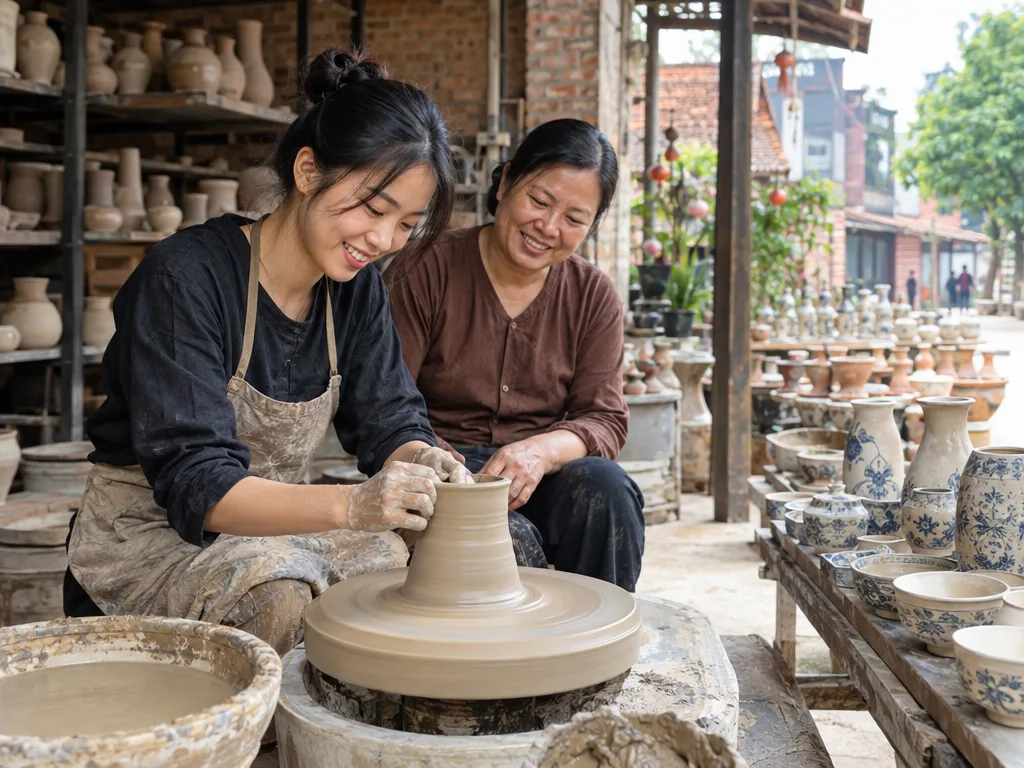
Bat Trang pottery village is close enough to Hanoi for an easy day trip, but it rewards travelers who give it more than a quick shopping stop. A full-day visit lets you combine a hands-on pottery activity, a walk through working village lanes, time to browse ceramics thoughtfully, and a slower look at how a craft community connects tradition with contemporary travel. This guide explains how to plan that day without pretending every workshop, road, or venue follows one fixed timetable.
Why plan a full day in Bat Trang?
Many visitors approach Bat Trang as a short excursion: arrive, buy a few bowls, and return to Hanoi. That can work, especially when your schedule is tight, but it leaves little space for the parts of the village that make the trip distinctive. Bat Trang is known for pottery and porcelain, and its identity is tied to a living craft economy rather than a single monument. The official local authority describes the traditional ceramic trade as something being preserved, developed, and adapted for new markets.
A full day gives you room to notice the difference between a retail display and a working place. You can watch clay become a shaped object, ask how pieces are finished, compare handmade variations, and leave time for quiet exploration. It also reduces the pressure to make every decision immediately. If a workshop is busy or weather changes your walking pace, you have flexibility instead of a rushed checklist.
A practical Bat Trang day-trip route
Use the route as a sequence, not a promise that every stop will take the same amount of time. Conditions vary, and independent workshops may welcome visitors differently from organized venues. The strongest plan has a clear first activity, an open middle, and a deliberate end-of-day buffer.
- Start with orientation. Begin by getting your bearings around the village center and identifying where you will return for transport. Notice the street layout, signs, and the difference between residential lanes, production spaces, galleries, and market-facing shops.
- Choose one pottery experience. A hands-on session or workshop visit gives the day a purpose beyond shopping. Ask what is included, whether finished pieces can be collected later, and how long the activity is expected to take before you begin.
- Pause for lunch. Keep the middle of the day unhurried. A local meal or simple break helps you avoid turning the village walk into a hot, tiring transfer between shops.
- Walk and browse selectively. Spend the afternoon comparing styles, glazes, sizes, and prices rather than buying from the first display. Leave room for a final collection point and your return journey.
If you are traveling with children, older relatives, or anyone who dislikes continuous walking, shorten the lane-walking portion and make the workshop the anchor. If you are especially interested in design or ceramics, reverse the order and reserve the afternoon for focused browsing.
Make the pottery activity the heart of the trip
What to ask before joining
Not every place offers the same kind of experience. Some activities are designed for casual visitors who want to shape a simple object; others are demonstrations, studio visits, or sales-oriented tours. Ask whether you will work with clay yourself, whether the item will be glazed and fired, and whether collection or delivery is handled separately. These questions are more useful than assuming a listing or an old blog post describes today's arrangement.
- How much time should you allow from arrival to finish?
- Can the activity accommodate children or first-time participants?
- Will your piece be fired, and how will you receive it?
- Are photos welcome during the demonstration?
- Is the price confirmed before the activity starts?
Expect a beginner activity to be about participation rather than producing a perfect vessel. Clay responds to pressure, moisture, speed, and balance. The value is in understanding the decisions behind a finished object and seeing why skilled makers rely on repetition and experience.
Look beyond the souvenir moment
Use the workshop to ask respectful questions about form, decoration, firing, and changing customer tastes. The local authority has recently highlighted the importance of preserving traditional techniques while improving products, training younger people, and responding to modern markets. That context makes a workshop visit more meaningful: you are not simply watching an old craft preserved unchanged, but seeing a living trade negotiate continuity and change.
Explore Bat Trang as a living village
After the workshop, walk with the awareness that Bat Trang is also a home and workplace. Quiet lanes may connect houses, studios, storage areas, cafés, and small shops. Keep to public routes, ask before photographing people or workspaces, and do not assume that an open doorway is an invitation to enter.
Look for details that a quick tour can miss: shelves of unfired forms, differences in surface texture, tools arranged for repeated tasks, and the way finished objects are packed for transport. Some displays emphasize familiar decorative patterns, while others show more modern shapes intended for everyday use. Comparing these choices can teach you more about the village than trying to visit every shop.
Build in time to stop without buying. A travel day becomes more respectful when the community is treated as a place rather than a backdrop. If a lane is crowded with deliveries or production work, step aside and let local activity continue. The best photographs are usually made after observing first, not by interrupting the scene.
How to shop for ceramics without rushing
Shopping is part of a Bat Trang day trip, but it works better when you decide what you actually want before entering a large display. Are you looking for a small, packable keepsake, a serving piece, a gift, or something for daily use? Your answer affects size, fragility, transport, and how much time you need for comparison.
- Check pieces under natural or even light for visible cracks, unstable bases, or rough edges.
- Ask whether an item is intended for food use if that matters to you.
- Compare similar forms across more than one seller before deciding.
- Confirm how fragile pieces will be wrapped for a bus, taxi, or flight.
- Keep receipts or seller details when you buy several items or arrange later collection.
Do not judge every variation as a defect. Handmade ceramics can differ slightly in shape, glaze, and decoration. Those differences may be part of the appeal, but you should still understand what you are buying and whether it meets your practical needs. Avoid bargaining theatrically or treating the maker's work as disposable. A calm question about the material, process, or intended use is usually more valuable than chasing the lowest possible price.
Food, rest, and pacing for different travelers
A full-day village visit is easier when you plan rests rather than waiting until everyone is exhausted. Wear shoes suited to uneven surfaces, carry water, and protect yourself from sun or rain. Weather can change the comfort of walking, so keep one indoor or shaded activity available as a fallback.
Families may prefer one workshop, an early meal, and a shorter browsing loop. Couples or solo travelers interested in craft can spend longer comparing galleries and talking with makers. A photography-focused visitor should schedule quiet time rather than trying to shoot every lane at peak movement. For anyone with mobility concerns, ask about vehicle drop-off, seating, stairs, and the distance between the workshop and the shops you want to visit; do not assume a traditional lane is step-free.
Food choices and opening arrangements change, so treat restaurant suggestions as flexible planning rather than fixed guarantees. If a particular meal matters, confirm locally on the day. The same principle applies to workshop availability, collection services, and seasonal events.
Getting there and managing the return
From Hanoi, Bat Trang is commonly planned as a nearby countryside excursion, but the actual journey depends on your starting point, traffic, weather, and transport choice. A private car or taxi can simplify carrying fragile purchases and returning at your preferred time. Public transport can reduce planning cost, but it may require more patience with connections, walking, and the timing of your final departure.
Whatever your transport, save the village name and your chosen meeting point in Vietnamese as well as English. If you arrange a return pickup, agree on a clear place that is easy to identify and leave a buffer after shopping. Ceramic purchases can take longer to wrap than expected, and a delayed workshop should not turn into a stressful race back to Hanoi.
Do not build the last part of the itinerary around an exact timetable unless you have confirmed it from the operator. Transport services and local access can change. A responsible day-trip guide should help you make decisions without inventing certainty.
Responsible ways to visit a pottery community
Bat Trang's craft economy depends on skills, businesses, workers, and residents, not only on tourism. Spend with independent makers or reputable local businesses when you can, follow safety instructions around kilns and equipment, and ask before touching unfinished work. Keep children close in production areas and respect any request not to photograph a process or person.
The local authority has also identified practical pressures around transport, goods movement, infrastructure, product quality, and connecting visitor sites. That is a reminder that tourism should fit into local life rather than overwhelm it. Walk carefully, avoid blocking loading areas, carry rubbish out when bins are not available, and choose purchases you can transport safely instead of creating avoidable damage or waste.
Sample schedules for a full-day visit
Balanced first visit
Use the first part of the day for arrival and orientation, then complete one pottery activity before lunch. After a break, walk through selected lanes and compare ceramics with a short list of intended purchases. Finish by collecting or packing your items and returning to the agreed transport point with extra time.
Craft-focused day
Choose a workshop or studio visit as the main event, then spend the afternoon discussing techniques, browsing fewer but more relevant galleries, and photographing details where permitted. This schedule suits travelers who would rather understand a small number of objects than collect a long list of stops.
Family-friendly day
Keep the route compact: one hands-on activity, an early meal, a short village walk, and a final shopping stop. Plan a rest period and avoid promising that children will enjoy every shop. The day works best when the activity is interactive and the adults accept a slower pace.
What to check before you leave Hanoi
- Confirm the day's transport plan and a return meeting point.
- Check whether your preferred workshop accepts walk-ins or needs advance arrangement.
- Ask about firing, collection, delivery, and packaging for handmade pieces.
- Bring water, sun or rain protection, comfortable shoes, and space for purchases.
- Keep a flexible backup plan if weather, traffic, or crowds change the route.
A well-planned Bat Trang pottery village day trip is not measured by how many shops you enter. It is measured by whether you had time to meet the craft, understand the place, make considered purchases, and return to Hanoi without rushing. Give the village a shape that fits your group, stay open to small discoveries, and let the working character of Bat Trang guide the day.

JOIN THE CONVERSATION
Comments (0)
No comments yet. Be the first to share a thought.