Choosing among private day tours from Hanoi is less about finding the longest itinerary and more about matching a route to your time, interests, energy, and preferred pace. A private guide and vehicle can make a day feel easier, but only when the plan leaves enough room for the destination itself. This guide explains how to compare private tours, what to ask before booking, and how to shape a realistic day without paying for features you will not use.
Start with the kind of day you actually want
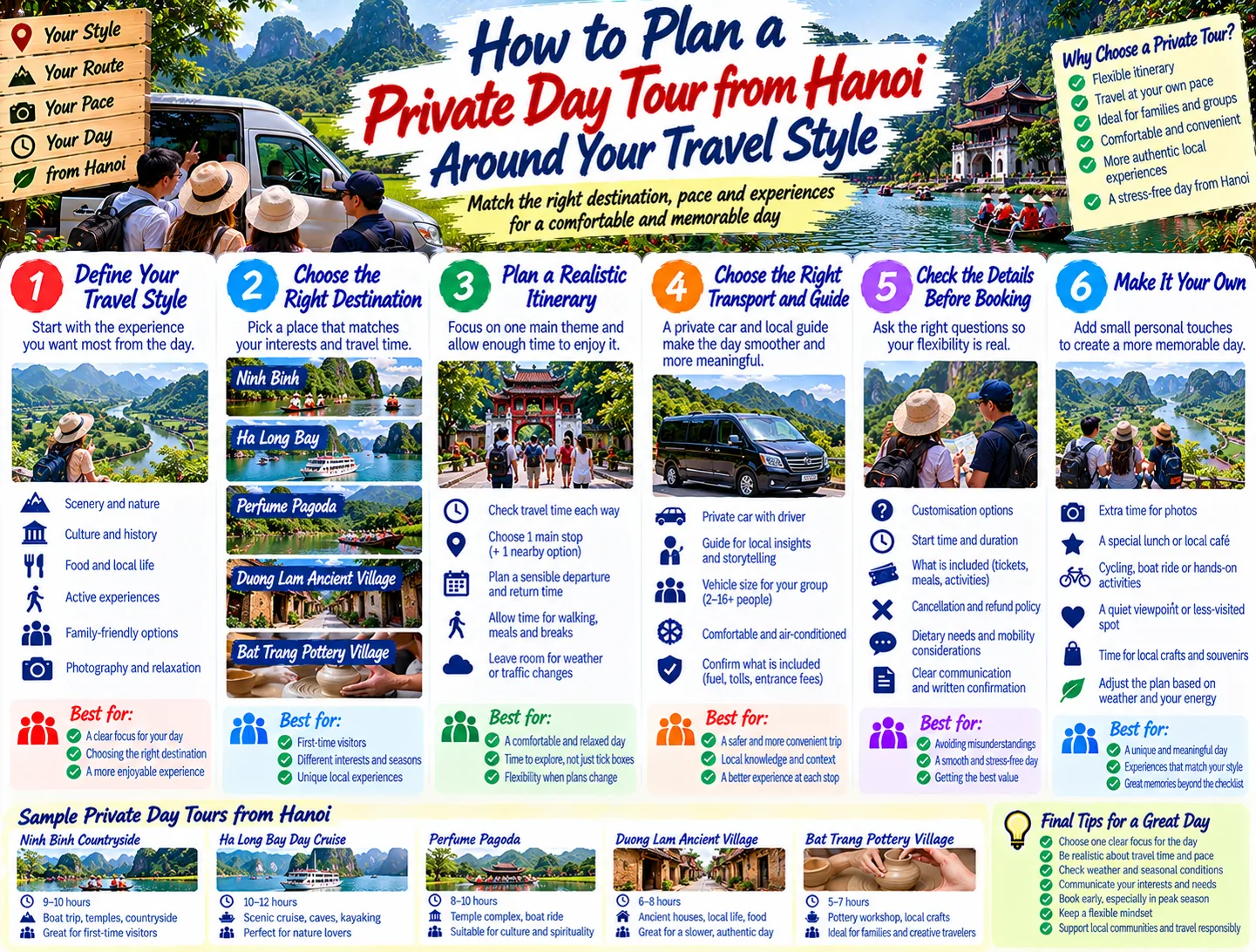
Search results often mix private car transfers, escorted sightseeing, family outings, photography trips, and fully tailored experiences under the same phrase: private day tour from Hanoi. Those products may look similar on a booking page, yet the day can feel completely different. Begin by writing one sentence that describes your ideal day. You might want a calm heritage visit, a landscape-focused outing, a food-and-culture route, or a fast overview of several highlights.
Then rank your priorities. A short list is more useful than a long wish list:
- Pace: relaxed, balanced, or maximum sightseeing.
- Focus: history, scenery, village life, food, photography, or a mixture.
- Comfort: door-to-door transport, air-conditioned vehicle, fewer changes, or a walk-heavy route.
- Flexibility: time for questions, spontaneous stops, and a later return.
- Group needs: children, older travellers, mobility limits, dietary concerns, or different fitness levels.
Hanoi is both a destination and a gateway to Northern Vietnam. The official Vietnam Tourism guide describes the capital through its historic streets, lakes, architecture, food culture, and heritage sites, while also presenting it as a base for exploring the wider region. That combination explains why a private tour can be valuable: it can connect your personal interests with a manageable route rather than treating every traveller as if they want the same highlights.
Choose the right destination before choosing the operator
A private tour cannot solve an unrealistic destination choice. Look first at what the day requires. A nearby craft or heritage outing may suit travellers who want more time with local details. A countryside route may work better for a slower day. A longer journey can be rewarding when the landscape is the main reason for going, but it deserves an early start and honest expectations about time on the road.
Match the route to your interests
For a cultural day, consider a route that gives one or two places enough attention instead of racing through four. For scenery, ask whether the itinerary includes time outside the vehicle and whether walking, steps, or a boat ride are involved. For food-focused travellers, confirm whether meals are included, whether the guide can explain local dishes, and whether the schedule allows a real meal rather than a quick stop.
Ninh Binh is a useful example of why route design matters. The official destination guide highlights its limestone landscapes, riverine scenery, paddleboat experiences, Hang Mua viewpoint, Hoa Lu, and nature areas. It also says Ninh Binh is about two hours from Hanoi by train or road and is served by many day tours from the capital. A private Ninh Binh day tour should therefore make a clear choice: scenery and a boat experience, history and temples, or a balanced combination. Trying to include every named attraction can turn a beautiful landscape day into a checklist.
Use the site's Ninh Binh day trips category for more ideas on realistic routes. If your priority is a historic rural setting closer to the capital, compare it with the Duong Lam Ancient Village category rather than assuming every countryside excursion offers the same experience.
Understand what “private” should mean
Private does not automatically mean fully customised. In one listing it may mean your own vehicle with a fixed schedule; in another it may include a private guide, flexible stops, hotel pickup, and a route adjusted around your interests. Ask the operator to define the term in practical language.
- Is the vehicle reserved only for your group?
- Is a guide included, and in which language?
- Can the start time be adjusted?
- Can you shorten or extend a stop when conditions allow?
- Are entrance tickets, boat trips, meals, parking, and other activities included?
- What happens if weather, traffic, or a late departure changes the plan?
A good private itinerary shows where flexibility is possible and where it is not. A ticketed attraction, a boat departure, a conservation rule, or a venue's operating schedule may limit last-minute changes. The honest answer is more useful than a promise that everything can be changed.
For a practical comparison framework, read How to Compare Day Trips from Hanoi. It can help you separate the headline price from the actual inclusions, travel time, and amount of usable time at the destination. For the broader question of whether a private format is worthwhile for your group, When a Private Day Tour Makes Sense provides a useful starting point.
Build a realistic timetable
The most common mistake in private day-tour planning is treating driving time as if it were part of the attraction. A day may begin with a hotel pickup, continue through city traffic, include a rural road, and end with a return journey during a busy period. The route needs breathing room for toilets, meals, short pauses, and unexpected delays.
Use time blocks instead of a crowded checklist
Ask for a simple time-block outline before booking. It should show an approximate departure, travel window, first main visit, lunch period, second main visit, and return range. Exact times may change, but the structure reveals whether the day is balanced.
For a long-distance outing, choose one anchor experience. That might be a boat trip, a major heritage site, or a viewpoint. Add one or two supporting stops only if they are close and genuinely complement the anchor. For a shorter route, you can spend more time talking with a guide, browsing a village, or taking a meal without feeling that you are losing sightseeing time.
The official Vietnam Tourism transport guidance notes that Vietnam offers taxis, buses, cyclos, trains, and other ways to get around, while countryside travel can involve different conditions from city travel. For a private tour, this is a reminder to ask about the vehicle, road sections, and walking involved rather than assuming that a private car makes the entire day effortless. The same guidance recommends planning transport ahead, especially around busy travel periods, so confirm the pickup window and return expectations before departure.
Compare vehicles, guides, and communication
The vehicle matters, but it is only one part of comfort. Ask how many people the vehicle is designed to carry with luggage, whether there is room to move comfortably, and whether the itinerary requires boarding a smaller vehicle or boat later. If anyone in your group gets carsick, ask which road sections are winding and whether stops can be planned.
A guide shapes the quality of a private day more than a polished itinerary often suggests. Look for evidence that the guide can interpret a place, not merely name it. You should be able to ask questions about history, customs, food, architecture, and everyday life. If your group has children, older travellers, or varied interests, tell the operator before confirmation so the guide can adjust explanations and pacing.
Communication should be clear before payment. You should know where pickup takes place, what contact method is used on the day, which language support is available, and how changes are handled. Save the final itinerary and the list of inclusions. If the operator uses different wording for “private car,” “private guide,” or “entrance included,” ask for clarification in writing.
Plan for different travel styles in one group
Private tours are especially useful when travellers do not all want the same thing, but only if the itinerary is designed around those differences. A family may need shorter walking sections and a predictable meal break. A couple may prefer photography time and a slower start. Older travellers may value fewer stairs and a vehicle that can get close to practical drop-off points. Friends may want a more active route and more time outdoors.
Questions worth answering early
- How much walking is required between the vehicle and each main site?
- Are there steep paths, stairs, uneven ground, or boat boarding steps?
- Can a traveller rest while others continue to a viewpoint or secondary stop?
- Can dietary restrictions be communicated clearly to the restaurant?
- Is there enough time for a child-friendly break without removing the main experience?
Do not describe a route as accessible unless the operator has confirmed the specific conditions. “Private” can improve coordination, but it does not remove stairs, uneven surfaces, rural paths, or the physical demands of a destination. Clear questions help the operator recommend a better route and help your group arrive prepared.
Know which extras add value
Some extras make a meaningful difference; others simply make a listing look fuller. A knowledgeable guide, reliable pickup, a comfortable vehicle, flexible pacing, and thoughtful destination interpretation often improve the day. A long list of nominal stops may not.
Evaluate extras by asking what problem they solve. A short orientation walk can make a historic area easier to understand. A village workshop may be worthwhile if you genuinely want to learn about the craft rather than only take a photograph. A meal is more valuable when the menu and dietary needs are clear. A boat outing deserves enough time to enjoy the water and landscape, not just to fit a transport segment into a packed schedule.
Be cautious with vague promises such as “hidden gems,” “VIP access,” or “no crowds” unless the operator explains what is actually included. Ask whether a stop is guaranteed, weather-dependent, seasonal, or simply suggested. Current opening hours, ticket rules, and local conditions can change, so a responsible operator should encourage you to reconfirm time-sensitive details before the day.
Use a simple booking checklist
Before confirming a private day tour from Hanoi, check the following:
- The exact destination and the main reason for choosing it.
- Approximate pickup and return windows, including traffic allowance.
- Vehicle type, group capacity, and whether transfers are private throughout.
- Guide language, guide role, and the level of customisation offered.
- Included and excluded tickets, meals, boat rides, parking, and tips.
- Walking, stairs, boat boarding, and other physical requirements.
- Weather, cancellation, rescheduling, and communication procedures.
- A final written itinerary that matches the conversation.
If two tours cost different amounts, compare them line by line rather than choosing from the headline price. One may include a guide and tickets while another charges for them later. Another may promise more stops but leave less time at each one. The best value is the plan that gives your group a satisfying day with fewer avoidable compromises.
Choose a private tour for control, not for speed
The strongest reason to book a private day tour is control: control over the pace, the questions you can ask, the balance between major sights and quiet moments, and the way the day fits your group. It is not necessarily the fastest way to collect the most locations.
Start with your preferred experience, choose a destination that fits the available time, and ask for transparent details about transport, guiding, inclusions, and physical demands. Then compare the proposed route with the practical advice in the site's Private Day Tours category and the destination-focused ideas in the Hanoi Countryside Tours category. With those checks in place, a private tour can turn a complicated day outside Hanoi into a focused, comfortable, and genuinely personal experience.
JOIN THE CONVERSATION
Comments (0)
No comments yet. Be the first to share a thought.