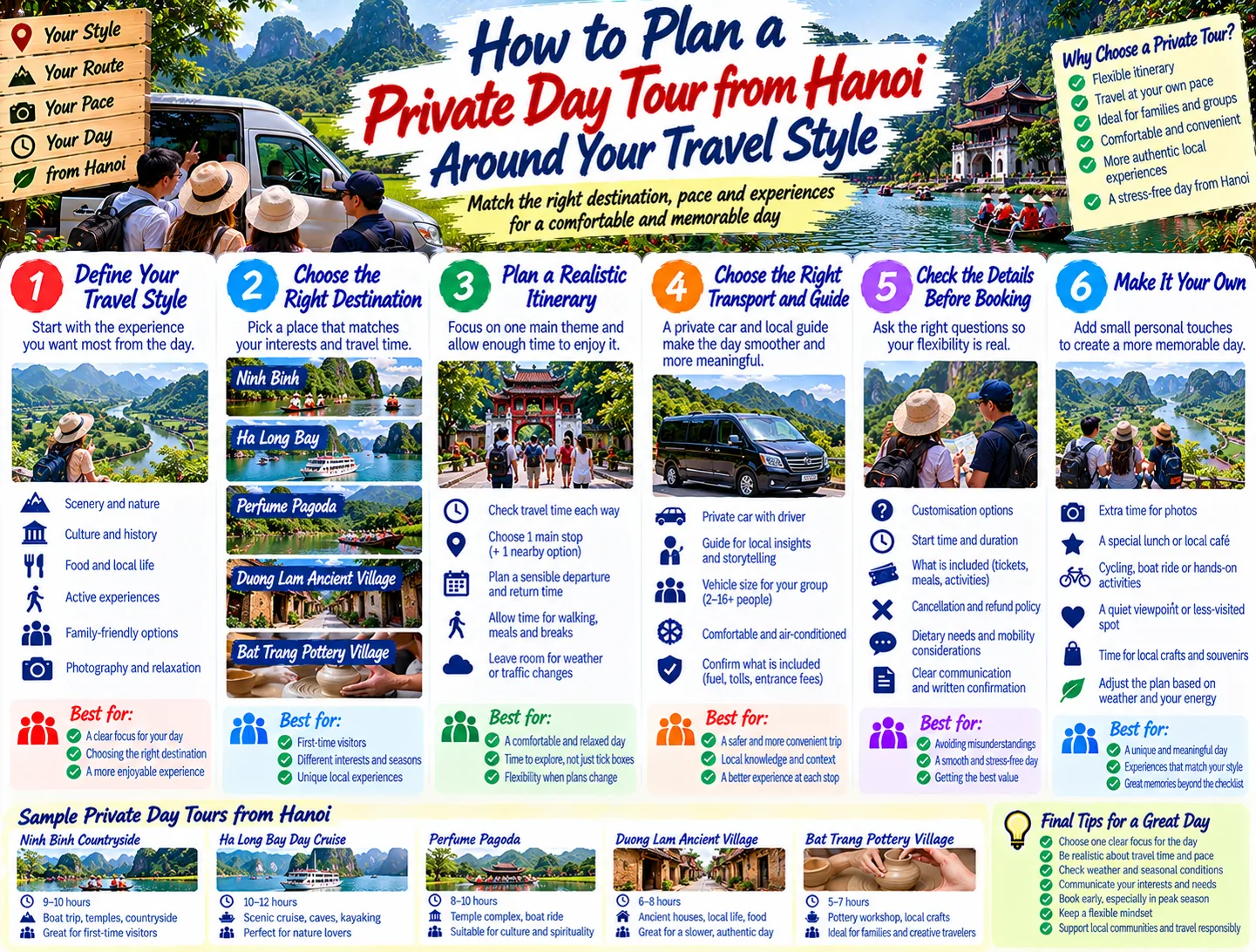
A private day tour from Hanoi is most valuable when it solves a planning problem rather than simply adding a private car to a standard itinerary. You can choose a destination that fits your energy, decide how much time to spend at each stop, and adjust the day when weather, traffic, or a late breakfast changes the plan. The best private day tours are not necessarily the ones with the longest list of attractions. They are the ones with a realistic route, clear inclusions, and enough breathing room to enjoy the places you came to see.
Start with the day you actually want
Before comparing vehicles or tour prices, define the experience. A couple looking for quiet landscapes may prefer a countryside route with one substantial cultural stop. A family may need shorter transfers, a flexible lunch, and permission to skip a viewpoint if children are tired. Friends may want a photographer-friendly schedule, while older travellers may value comfortable access and fewer stairs more than a packed sightseeing list.
Write down three priorities and one limit. Your priorities might be scenery, local food, heritage, photography, or a gentle pace. Your limit could be an early start, a long drive, steep steps, boat travel, or returning late to Hanoi. This simple exercise makes it easier to reject an attractive itinerary that is technically possible but unpleasant in practice.
Match the destination to the purpose
For a landscape-led private day tour, Ninh Binh combines limestone scenery, waterways, viewpoints, and historic sites. The official Vietnam Tourism destination guide describes it as roughly two hours from Hanoi by road or train and highlights sampan trips, Hang Mua, Hoa Lu, and nearby nature experiences. That mix works well when your group wants variety, but it also means you should choose a small number of priorities instead of attempting everything.
Ha Long is a different proposition. Vietnam Tourism describes the journey from Hanoi as about two and a half hours by road, with cruise transfers from Tuan Chau and Bai Chay. A private arrangement can help coordinate the road transfer and your preferred pace, but a bay excursion still depends on the operator, port procedures, weather, and the day’s sailing programme. Treat it as a cruise day with transport, not as an ordinary city sightseeing loop.
Closer countryside destinations can be better for travellers who want more time in a village, craft workshop, temple, or local meal. Browse the Hanoi countryside tours category for ideas that focus on a slower escape rather than a long-distance checklist.
Build a route around travel time
The most common private day tour mistake is measuring the day by attractions rather than by movement. A route that looks short on a map can take longer because of city traffic, rural roads, stops for comfort, loading time, and the practical pace of a group. Ask for a door-to-door outline: estimated departure window, first arrival, time at each main stop, lunch location or format, final departure, and expected return range.
A useful rule is to give the day one anchor experience and two or three supporting stops. In Ninh Binh, the anchor might be a boat journey, with a viewpoint and a historic site added only if the timing remains comfortable. In a craft village, the anchor could be a hands-on activity, with a market walk and meal around it. In Ha Long, the cruise is the anchor; avoid adding unrelated detours merely to make the itinerary look fuller.
Use a simple route test
- Can the group spend at least an hour enjoying the main experience rather than rushing through it?
- Are the stops arranged in a sensible geographic order?
- Does the plan include realistic time for lunch, toilets, traffic, and boarding?
- Is there a clear point where the guide can remove a minor stop?
- Does the return time leave a buffer for evening plans in Hanoi?
If the answer to several questions is no, the itinerary needs editing. A private tour should create control, not encourage the operator to promise every possible attraction.
Choose the right level of flexibility
Flexibility has different meanings, so confirm which one you are buying. It may mean choosing your pickup time, changing the order of stops, shortening a visit, selecting a different lunch, or having a private vehicle instead of joining a coach. It does not always mean that entrance tickets, boat departures, weather-sensitive activities, or port schedules can be changed at the last minute.
Ask the organiser three direct questions. Which parts of the itinerary are fixed? Which parts can be shortened or removed? What happens if rain, storms, a road delay, or a closed attraction affects the plan? The answer should identify a practical alternative, not simply promise that everything will be fine.
For a broader comparison of trade-offs, read How to Compare Day Trips from Hanoi. Then return to your own priorities: a private tour is worth considering when the ability to shape the day matters more than finding the lowest advertised rate.
Check what the private tour includes
“Private” normally describes the group arrangement, but it does not automatically tell you what is included. Request a written breakdown covering vehicle and driver, guide language, hotel pickup area, fuel or road costs, entrance fees, boat or cruise tickets, meals, drinks, gratuities, and any optional activity. If the tour crosses a town or attraction with separate local services, ask who purchases those tickets and when.
Vehicle comfort deserves specific questions. How many travellers and bags can the vehicle carry? Is there air conditioning? Can the group stop for breaks? Is the vehicle suitable for the road and the number of people booked? A small private group may benefit from a smaller vehicle, while a family with luggage or mobility needs may need more space.
Look beyond the headline price
A low quote may exclude the exact parts that make the day convenient. A higher quote may be reasonable if it includes a private guide, door-to-door transport, entrance fees, and a genuinely small group. Compare like with like by asking for the total expected cost and a list of exclusions. Avoid judging a tour by the number of destinations named in its title.
Also check the cancellation and weather policy before paying. You do not need a dramatic warning to ask; this is ordinary trip planning. The policy should explain what happens if you cancel, if the operator cancels, or if a weather-related activity is unavailable.
Plan timing without over-planning
Start time affects more than the alarm clock. An early departure can reduce the first leg of city traffic and leave more time at the destination, but it may be a poor choice for travellers arriving late or travelling with young children. A later start can feel easier while leaving less room for a long-distance route. Pick the earliest departure your group can sustain comfortably, then protect the main experience from unnecessary additions.
Weather and daylight also matter. Outdoor viewpoints, boat rides, village walks, and photography are experienced differently in heat, rain, mist, or strong sun. Do not promise a perfect view or fixed conditions. Instead, ask whether the route can be reordered and whether there is an indoor or cultural alternative if the weather turns.
For families, timing should include pauses rather than merely shorter attractions. The guidance in Choosing a Day Trip the Whole Family Can Enjoy is useful when you are balancing different energy levels. A private vehicle helps, but it cannot remove the physical demands of stairs, heat, walking surfaces, or a long day away from the hotel.
Make the guide part of the decision
A good private guide does more than repeat facts. They interpret what you are seeing, manage transitions, notice when the group needs a pause, and explain local etiquette without making the day feel like a lecture. Before booking, explain what your group enjoys and ask how the guide normally adapts the route.
Language ability is important, but so is communication style. If your group wants food recommendations, photography time, quiet observation, or historical depth, say so in advance. If anyone has mobility, dietary, medical, or sensory needs, disclose that early. The goal is not to demand an impossible itinerary; it is to give the organiser enough information to plan responsibly.
Private touring also creates a closer relationship with local places. In a village, temple, pagoda, or family-run workshop, follow the guide’s advice about clothing, footwear, photography, and where to walk. Ask before photographing people, homes, religious activity, or working spaces. A flexible tour should be considerate, not intrusive.
Choose internal links that help you decide
Different private day tours suit different travellers. If you are still comparing landscapes and distances, the day trip planning and comparisons category can help you structure the decision. If you want a specific cultural setting, explore the Duong Lam Ancient Village category or the Bat Trang Village Trips category.
For a gentle nature-focused plan, the article A Nature-Focused Day in Ba Vi shows why one clear theme can be more satisfying than a rushed circuit. For a more demanding historical and landscape day, Ninh Binh day trips offer a useful starting point for comparing what can realistically fit into one schedule.
Use a pre-departure checklist
Two or three days before departure, confirm the pickup address, contact number, departure window, vehicle type, guide language, included tickets, meal arrangements, and payment terms. Ask whether you should bring a passport or identification for a booked activity. Check the forecast, but treat it as planning information rather than a guarantee.
- Wear shoes suitable for uneven paths, steps, or damp surfaces.
- Carry water, sun protection, a light layer, and any personal medication.
- Bring a small bag rather than luggage that must stay in the vehicle all day.
- Keep a little cash for drinks, snacks, donations, or small local purchases where appropriate.
- Save the organiser’s contact details and agree on what to do if the group is separated.
On the morning itself, make sure everyone knows the one non-negotiable part of the plan and the latest reasonable return time. That shared understanding prevents small delays from turning into frustration.
When a private day tour is the right choice
A private day tour makes the most sense when your group has a clear reason to value control: different ages or energy levels, a special interest, limited time in Hanoi, a need for direct hotel pickup, or a destination where coordinating several transport steps would be tiring. It is less compelling when you want the cheapest possible transport, enjoy meeting strangers, or have not yet decided what you want from the day.
Use privacy to improve the experience, not to inflate the itinerary. Choose one meaningful anchor, keep the route geographically sensible, verify inclusions, and leave enough margin for real travel conditions. With those basics in place, a private day tour can turn a complicated day outside Hanoi into a calm, well-shaped part of your trip.
JOIN THE CONVERSATION
Comments (0)
No comments yet. Be the first to share a thought.