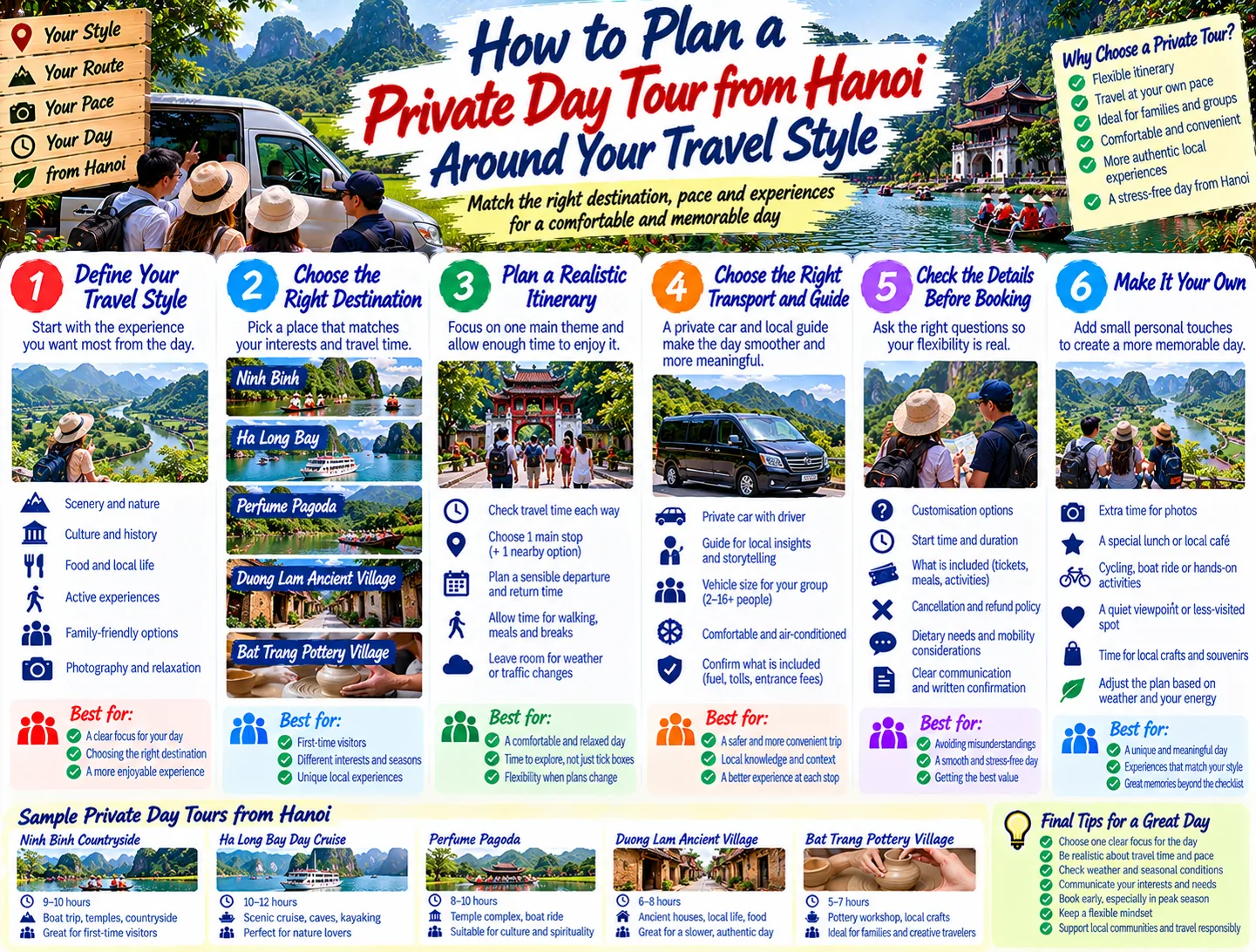
A private day tour from Hanoi is most useful when it solves a planning problem, not when it simply puts a car and a long list of stops together. You may want countryside scenery without a dawn-to-dusk rush, a cultural visit that leaves room for conversation, or a route that works for travelers with different energy levels. The advantage of a private itinerary is the ability to shape the day around those priorities.
This guide explains how to choose the right route, set a realistic pace, and turn a vague request for “something private” into a day that feels comfortable and worthwhile. It also shows which questions to settle before booking, so flexibility is real rather than just a selling point.
Start with the kind of day you actually want
Begin with the experience, not the destination name. A private day tour from Hanoi can be built around scenery, history, food, craft, photography, light activity, or simply time away from the city. Those choices lead to different routes and different expectations.
Match the route to your travel style
For scenery: choose one main landscape and protect time for viewpoints, a calm meal, and unhurried stops.
For culture: prioritize a village, heritage site, workshop, or local explanation rather than stacking several attractions.
For active travelers: ask how much walking, cycling, climbing, or boat time is involved and whether alternatives exist.
For mixed groups: plan a shared anchor experience with optional lighter activities around it.
For photographers: discuss light, crowds, weather, and whether the guide can adjust the order of stops.
If your starting point is still broad, the site’s guide to comparing day trips from Hanoi is a useful first filter. Once you know whether your priority is nature, heritage, or a slower countryside day, a private tour becomes easier to design.
Choose one strong theme instead of an overfilled route
The most common mistake in a customizable Hanoi day trip is treating flexibility as permission to add everything. A route that includes a distant landscape, a village, several viewpoints, a special meal, and shopping may look impressive on paper but feel fragmented in practice. Private touring works better when one theme leads and the rest supports it.
Three practical route shapes
One destination, deeper visit: This is the best shape when the place itself deserves attention. You can spend more time walking, asking questions, eating without watching the clock, and adapting to weather or energy.
One main stop plus a nearby complement: This works for travelers who want variety but still need a coherent day. A major cultural or natural experience can be paired with a short village, food, or viewpoint stop if the geography genuinely supports it.
A flexible countryside loop: This suits repeat visitors or people who prefer atmosphere over a checklist. The itinerary can include back roads, local landscapes, and a few agreed priorities, but it should still have a clear latest departure time.
For destination ideas, browse the Hanoi Countryside Tours category and the Day Trip Planning & Comparisons category. Use them to compare the character of different days, not to copy every stop into one itinerary.
Build the day around travel time and energy
A private vehicle gives you more control, but it does not remove distance, traffic, queues, heat, rain, or the time needed to enjoy a place. Ask the operator to describe the day in blocks: departure, main travel, first experience, lunch, second experience, return, and a realistic arrival window. This is more useful than a list of place names.
Use a pace that leaves room for the destination
For many travelers, the ideal day has one substantial experience before lunch and one lighter element afterward. That structure creates a natural reset and makes it easier to shorten the afternoon if the weather changes. If the route includes a long drive, avoid promising several “quick stops”; getting in and out repeatedly can make a private trip feel like a transfer service.
Ask specifically about walking surfaces, stairs, boat boarding, toilet access, shaded areas, and where the vehicle can wait. These details matter for older travelers, young children, anyone recovering from an injury, and anyone who simply prefers a gentle day. If you have mobility concerns, describe them in practical terms rather than assuming the phrase “easy walking” means the same thing to everyone.
Transport choices should also be discussed early. Vietnam’s official tourism guidance notes that travelers can combine road, rail, buses, taxis, cycling, and motorbikes, while countryside cycling can be appealing in the right setting. For a private tour, the useful question is not whether every mode is available; it is which combination protects your time and comfort. Use official transport guidance as background, then ask the operator what is actually included in your route.
When comparing proposals, ask where the vehicle will meet you, whether the route is designed as a private transfer or as a guided day, and how much time is reserved for the return. A driver who can adjust the order of stops is helpful, but the itinerary should still show a sensible geographic sequence. You can also ask whether the guide travels with you throughout the day or joins at selected sites. That distinction affects how much interpretation, local context, and help with transitions you can expect.
Make flexibility specific before you book
“Flexible itinerary” should describe decisions you can really make on the day. It may mean changing the order of stops, spending longer at one place, skipping an optional activity, choosing a different lunch arrangement, or returning earlier. It usually does not mean that every distant destination can be added without affecting the schedule.
Questions that reveal the real level of customization
Can the departure time move within a reasonable window?
Which stops are essential, and which are genuinely optional?
Can the route be shortened if rain, heat, or fatigue becomes an issue?
Can the guide adapt explanations for first-time visitors, children, or returning travelers?
Is lunch chosen in advance, selected on the day, or left entirely to the guide?
What happens if a site is crowded or a road condition changes the plan?
Are entrance fees, boats, meals, guide service, and transport all clearly separated?
Good answers are concrete. “We will see how the day goes” is less helpful than “you can choose between the longer walk and the shorter visit after lunch.” A private tour should give you a decision framework, not make you negotiate every detail while the clock is running.
Plan for weather without making the day feel uncertain
Weather is one reason a private day tour from Hanoi can be more comfortable than a fixed group departure. The route can sometimes be reordered, a viewpoint can be replaced with an indoor visit, or the day can put its most weather-sensitive activity first. That does not guarantee perfect conditions, but it can reduce the feeling that one shower has ruined the itinerary.
Vietnam’s official tourism climate guide describes Hanoi as cooler, mistier, and cloudier from December to March; warmer and often clearer from April to June; hot, humid, and rainy from June to August; and cooler with clearer skies from September to November. Treat those patterns as planning context rather than a promise for a particular date. A flexible booking conversation should cover what happens in heavy rain, extreme heat, poor visibility, or a forecast that affects boats and outdoor walks.
Ask for a weather backup, not a second full tour
A practical backup might be a shorter walk, a craft or food-focused stop, more time in a heritage setting, or an earlier return. It should be geographically sensible and agreed in advance. If the proposed alternative requires a completely different part of northern Vietnam, it is probably not a backup; it is another tour.
Bring the items that make flexibility usable: comfortable shoes, sun protection, a light rain layer, water, and enough space in your schedule to avoid rushing. Those are simple preparations, but they allow the guide to adjust the day without turning every change into a problem.
Use internal research to shortlist the right destination
Before choosing a private itinerary, compare the kinds of experiences already covered across the site. A nature-led plan may resemble a nature-focused day in Ba Vi, while a heritage-led plan may be closer to a considerate visit to Duong Lam. These are not instructions to combine both; they help you identify what you want the private format to improve.
For a village-centered day, consider whether you want demonstrations, architecture, food, shopping, or conversations with local hosts. For a nature-centered day, decide whether the priority is a viewpoint, forest atmosphere, a boat journey, or a short active section. For a major destination farther from Hanoi, ask whether the time on the road is justified by the experience you will have after arriving.
A useful shortlist has two or three options, each with a different reason to choose it. For example: the easiest day physically, the most distinctive cultural day, and the best landscape day in the forecast. This makes the final decision clearer than asking an operator for “the best private tour” without explaining what best means to you.
Protect the quality of the experience
Private does not automatically mean personal. The quality of the day depends on communication, pacing, and whether the guide understands the purpose of your visit. Tell the operator what you do not want as clearly as what you do want: no forced shopping, no rushed photo stops, no strenuous walk, no long unplanned lunch, or no lecture-heavy schedule.
Also agree on the tone of the day. Some travelers want continuous interpretation; others prefer quiet time in the landscape. Some want local food suggestions; others need careful attention to dietary limits. If the group includes different preferences, say so before the itinerary is finalized. A good private day tour can make room for difference, but only when those differences are visible in the planning.
Finally, keep the return journey in mind. If you have an evening train, flight, show, or reservation in Hanoi, give yourself a conservative buffer and confirm the drop-off area. The value of a flexible tour is reduced if the last hour becomes a race against traffic.
Conclusion: let private touring serve the day
The best private day tours from Hanoi are not the ones with the most inclusions. They are the ones with a clear purpose, a manageable route, honest travel-time expectations, and enough flexibility to respond to people and weather. Choose one strong theme, ask what can really change, and make comfort part of the itinerary rather than an afterthought. With that foundation, a private day tour from Hanoi can feel less like a packaged excursion and more like a day designed for your travelers.
JOIN THE CONVERSATION
Comments (0)
No comments yet. Be the first to share a thought.