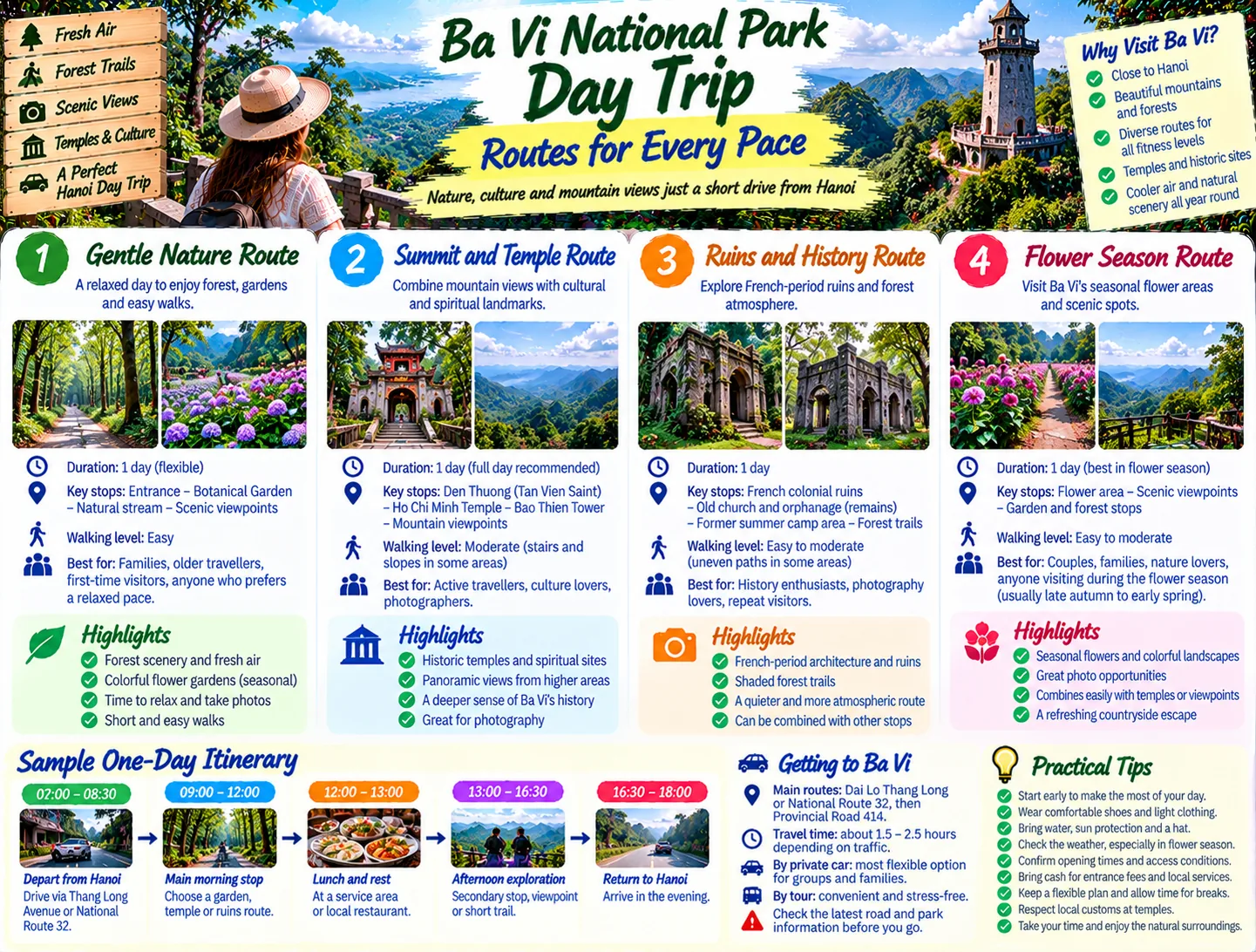
Ba Vi National Park is one of the easiest ways to turn a Hanoi day trip into a day of forest roads, mountain air, viewpoints, and cultural landmarks. The challenge is not finding things to do; it is choosing a route that matches your time, transport, fitness, and appetite for walking. A good Ba Vi National Park day trip should feel unhurried, while still leaving enough time for the places you most want to see.
This guide uses the park’s published visitor information to build practical route choices rather than one rigid timetable. You will find a gentle nature day, a summit-and-temple plan, a flower-season option, and a flexible approach for families or private groups. For broader destination comparisons, see How to Compare Day Trips from Hanoi, then use the Ba Vi Nature Trips category for more ideas.
Why Ba Vi works as a Hanoi day trip
Ba Vi National Park is a protected mountain landscape with forest, streams, viewpoints, historic traces, and religious sites. The official park overview describes three main peaks: Vua at 1,296 metres, Tan Vien at 1,227 metres, and Ngoc Hoa at 1,131 metres. It also presents the park as a place for biodiversity conservation, ecological tourism, recreation, and visits to historic and cultural landmarks.
That mix gives Ba Vi a different rhythm from a sightseeing loop built around several unrelated stops. You can spend most of the day in the landscape, with short cultural visits woven into the route. The road climbs through changing scenery, and the final experience depends heavily on whether you want a relaxed forest outing or a more active mountain day.
It is also useful to think of Ba Vi as a group of route choices rather than a single attraction. The park’s own tourism page lists spiritual routes, French-period ruins, and nature-focused trails. That makes it easier to plan around the people in your group instead of trying to cover every named point in one visit.
Choose your Ba Vi itinerary by travel style
For a gentle nature day
Choose the forest and botanical sights if your priority is fresh air, scenery, and time outdoors without turning the trip into a demanding hike. The official route list includes a botanical garden and a natural bathing stream among its nature options. You can combine a short walk with scenic driving, a picnic-style break where permitted, and one cultural stop.
This route suits travelers who want a countryside reset, older visitors who prefer a slower pace, or anyone arriving after several busy days in Hanoi. Allow time for stops rather than measuring success by the number of locations completed. The park is more rewarding when you pause to notice the forest, temperature, and changing views.
For a summit-and-temple day
Travelers seeking a stronger sense of place can build the day around the mountain temples and upper viewpoints. The park lists Den Thuong, the temple associated with Tan Vien Saint, and the Ho Chi Minh Temple with Bao Thien Tower among its spiritual routes. These visits add history and cultural meaning to a nature trip, but they also require more walking and attention to the road and stairs.
Do not treat this as a race between temples. Pick one main religious site and one secondary stop, then keep a buffer for walking. Wear shoes with secure soles, carry water, and dress respectfully. If your group includes people with different mobility levels, agree in advance on a meeting point rather than expecting everyone to complete every uphill section together.
For ruins and atmosphere
The park also identifies remnants connected with the French period, including an old summer-camp area, a former church and orphanage, and a political prison site. This is a good choice for visitors who enjoy atmosphere, photography, and layered history more than a conventional list of viewpoints.
Ruins can be uneven, damp, or visually subtle. Build the visit around careful walking and observation, not just photographs. The most satisfying version of this route pairs one historic area with a forest stop, so the day does not become a sequence of similar walls and paths.
A practical one-day Ba Vi route
Morning: enter, climb, and choose one anchor
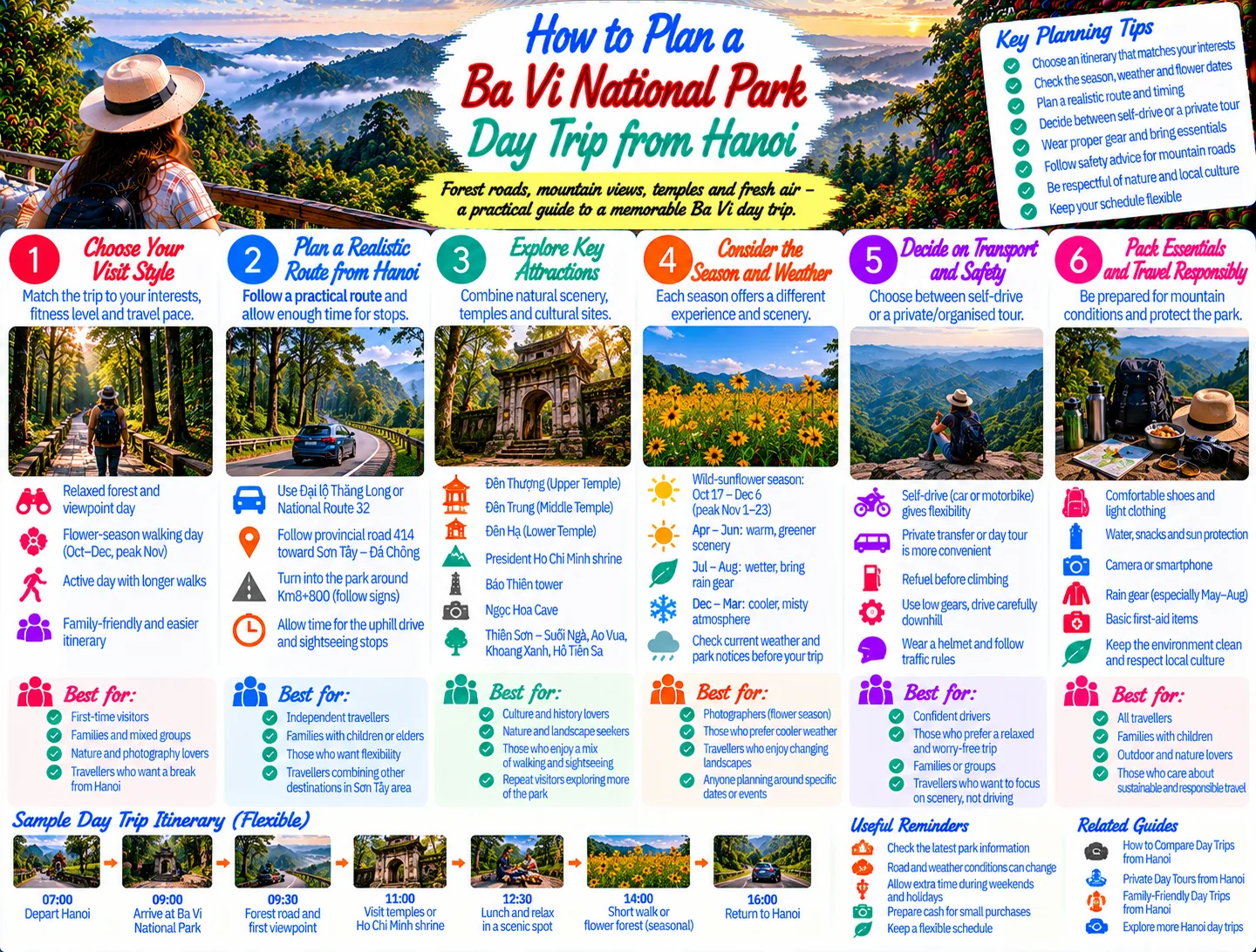
Leave Hanoi early enough to reach the park with time in hand. The official park’s current flower-season guidance directs visitors from Hanoi via Dai Lo Thang Long or National Route 32, then toward Provincial Road 414 and the park entrance. Because road conditions, traffic, and operating arrangements can change, check the park’s current notices before departure rather than relying on an old map screenshot.
After entry, make one main stop your anchor. Nature-focused travelers can begin with the forest and botanical areas. Culture-focused travelers can head toward a temple route. If you are visiting during a seasonal flower period, prioritize the flower area before the busiest part of the day and leave flexible time for walking.
Midday: keep the middle of the day flexible
Ba Vi is best planned with a flexible middle section. Stop for lunch or a rest at a suitable service area, then decide whether the group still has energy for a second trail. The park’s visitor guidance mentions food, accommodation, and camping-related services in different areas, but availability can change, so confirm directly if your plan depends on a particular meal, room, or overnight arrangement.
For a private tour, this is where the itinerary can be adjusted most easily. A driver and guide can reduce the pressure to fit everyone into the same pace, while a self-drive group should be especially disciplined about breaks, downhill driving, and not rushing between stops.
Afternoon: finish with a short, memorable stop
Use the afternoon for a stop that feels complete on its own: a viewpoint, a final forest walk, a cultural site, or a seasonal flower trail. Avoid adding a distant attraction simply because it appears nearby on a map. Mountain roads and walking time can make a short-looking connection longer than expected.
If you are comparing transport styles, the site’s guide to when a private day tour makes sense can help you decide whether flexibility is worth paying for. For a slower overall day, compare this trip with the options in Hanoi Countryside Tours.
Ba Vi flower season: how to plan around it
Ba Vi’s official 2026 guidance says wild sunflower, also called da quy, is expected to flower from October 17 to December 6, with the strongest display from November 1 to November 23. These are time-sensitive dates for 2026, not a permanent annual guarantee, so check the park’s latest announcement for the year you travel.
The same guidance describes a flower forest reached after the ticket-control area and the pine forest around the 400-metre point. It says visitors can park and walk roughly 300 metres to the flower forest, which covers nearly 10 hectares and has a walking trail of more than 3 kilometres. That makes flower season suitable for travelers who want a defined walking experience rather than a long mountain hike.
Expect heavier demand on weekends and peak bloom days. The park specifically recommends weekday visits to reduce crowding and possible traffic congestion. Go for the landscape rather than treating the flowers as a studio backdrop: stay on the walking route, do not pick blooms, and take rubbish with you.
Tickets, road safety, and what to confirm
The park’s 2026 flower-season notice lists adult admission at 60,000 Vietnamese dong per person, with separate rates for students, school pupils, and priority visitors. It also lists parking charges for cars, motorbikes, and bicycles. These figures are a dated notice for the 2026 season, so confirm the current rate before you travel and bring the identification needed for any reduced fare.
The same official notice gives unusually practical driving advice: check the vehicle before climbing, add fuel, use low-traction footwear for walking, and do not switch off the engine, coast in neutral, or let a vehicle roll downhill. It also says that dangerous riding, altered noisy motorbikes, missing helmets or licences, and alcohol-impaired driving can lead to refusal of service without a refund.
Those instructions matter because Ba Vi is not just a flat park reached by a short path from a car park. Plan for bends, elevation, changing weather, and the difference between driving time and walking time. If anyone in the group is uncomfortable driving on mountain roads, a private transfer can make the day calmer.
What to pack for a comfortable visit
Comfortable shoes with a secure sole for stairs, forest paths, and the flower trail.
Water and small snacks, especially if your route includes several walking sections.
Sun protection and a light extra layer, since mountain conditions can feel different from Hanoi.
Identification if you may qualify for a student, pupil, or priority ticket.
A phone with offline directions and the park’s current contact details saved.
A small bag for rubbish and personal items; keep the forest cleaner than you found it.
Pack for the route you have chosen, not for an imaginary expedition. A gentle forest day does not require heavy hiking equipment, while a temple-and-ruins itinerary deserves more attention to footwear, water, and rest breaks.
Ba Vi day trips for families and private groups
Families should decide whether the priority is scenery, flowers, ruins, or cultural visits before setting out. A child-friendly route usually works better with one main walk, one shorter stop, and time to rest than with a long list of mountain landmarks. The broader advice in Choosing a Day Trip the Whole Family Can Enjoy is useful when ages and energy levels differ.
Private groups can use the same principle: agree on the day’s anchor, then leave two optional stops rather than promising everything. If one person wants a longer walk and another prefers scenery from the road, split the plan briefly and reunite at a clear location. A good Ba Vi itinerary is coordinated, not crowded.
How Ba Vi compares with other Hanoi escapes
Choose Ba Vi when you want mountain scenery, forest air, seasonal nature, and the option to add temples or historic traces. Choose a village-focused trip when architecture, craft, and everyday heritage are more important. Choose a broader countryside route when you want a gentler day with less elevation. The site’s unhurried countryside escape guide offers a useful contrast.
Ba Vi also rewards repeat visits because the emphasis can change with the season. One trip may focus on flowers, another on forest and ruins, and another on spiritual sites. That flexibility is its strength: you do not need to see every attraction for the day to feel worthwhile.
Conclusion: build the day around one clear experience
The best Ba Vi National Park day trip is not the one with the longest checklist. Choose one clear experience—forest, flowers, temples, ruins, or a balanced mix—then give it enough time. Check the park’s current notices for dates, prices, access, and rules; plan conservative driving and walking time; and keep the afternoon flexible. With that approach, Ba Vi becomes a practical, refreshing escape from Hanoi rather than a rushed collection of stops.
JOIN THE CONVERSATION
Comments (0)
No comments yet. Be the first to share a thought.