A Ba Vi National Park day trip is one of the simplest ways to trade Hanoi’s busy streets for mountain air, forest roads, and viewpoints without committing to a long northern Vietnam journey. The park sits in the Ba Vi mountain range west of Hanoi, with steep terrain, high peaks, old forest, and a cooler feel than the city. It is not a single, compact attraction: the experience depends on how far you travel uphill, how much walking you want, and whether you prefer scenery, quiet nature, or a fuller countryside day.
This guide explains how to plan a practical Ba Vi National Park day trip from Hanoi, what to expect on the mountain, which route styles work for different travellers, and how to avoid the common mistake of trying to fit every possible stop into one rushed schedule. For wider route comparisons, see How to Compare Day Trips from Hanoi, then use the advice below to decide whether Ba Vi suits your day.
Why choose Ba Vi for a day trip from Hanoi?
Ba Vi appeals to travellers who want a nature-focused escape rather than a checklist of monuments. The destination combines a protected mountain landscape with roads that climb through thick vegetation, so the journey itself becomes part of the outing. At higher elevations, the atmosphere can feel markedly different from Hanoi, especially when cloud or mist moves through the trees.
The park is associated with three main peaks in the Ba Vi range. Vua Mountain is the highest at about 1,296 metres, while Tan Vien and Ngoc Hoa are also prominent summits. The park’s scale matters when planning: a visit can be a gentle scenic drive with short walks, or a more active day involving steps, uneven ground, and sustained walking.
Choose Ba Vi if you want:
- a mountain and forest setting within reach of Hanoi;
- a flexible day that can be adapted to your energy level;
- fresh scenery, viewpoints, and shaded walking rather than intensive sightseeing;
- a private or small-group trip where stops can be paced naturally.
If your priority is a dense schedule of cultural attractions, compare it with the slower village focus described in A Countryside Escape from Hanoi at an Unhurried Pace. Ba Vi is best understood as a landscape day, not a guaranteed sequence of timed attractions.
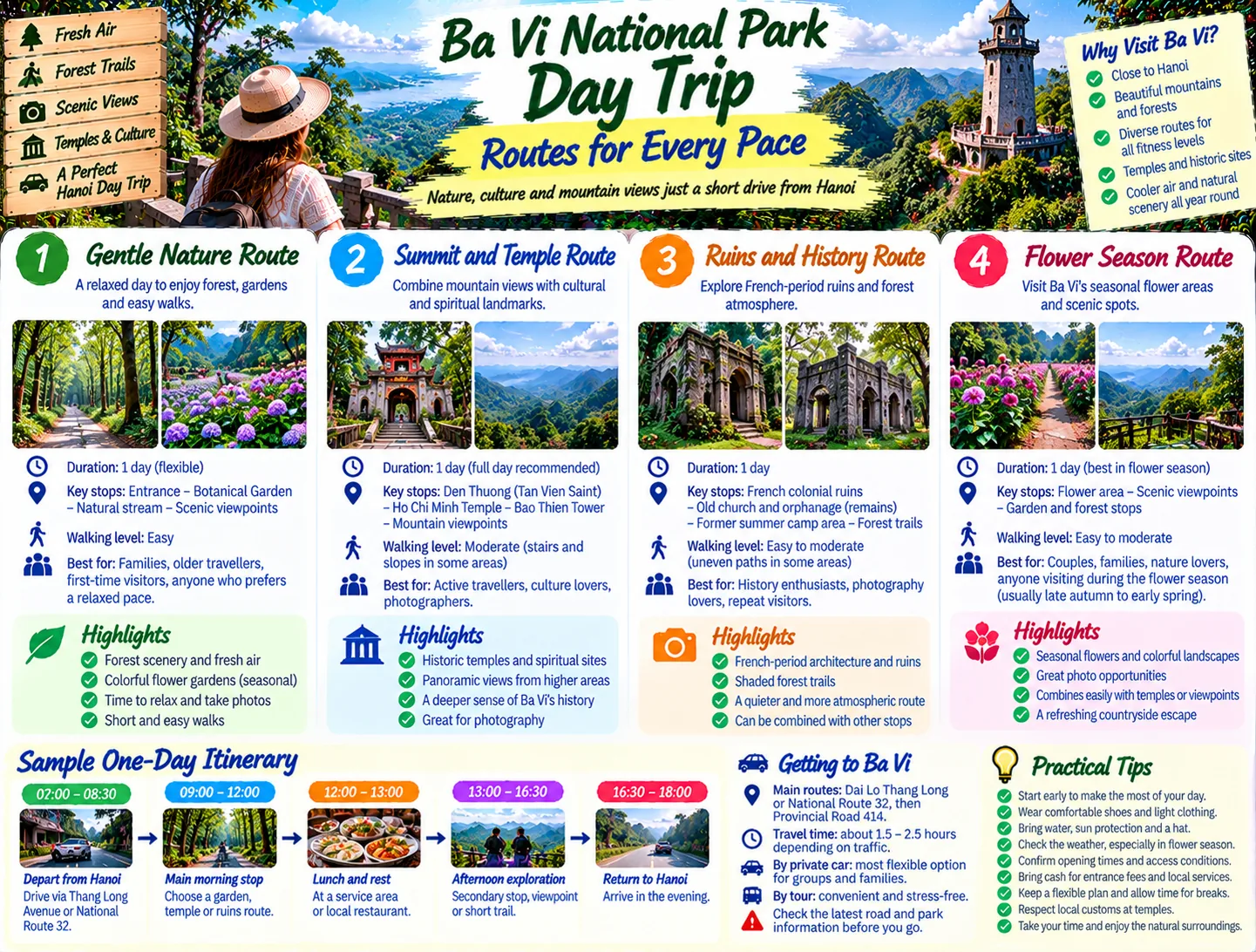
How to structure a Ba Vi National Park itinerary
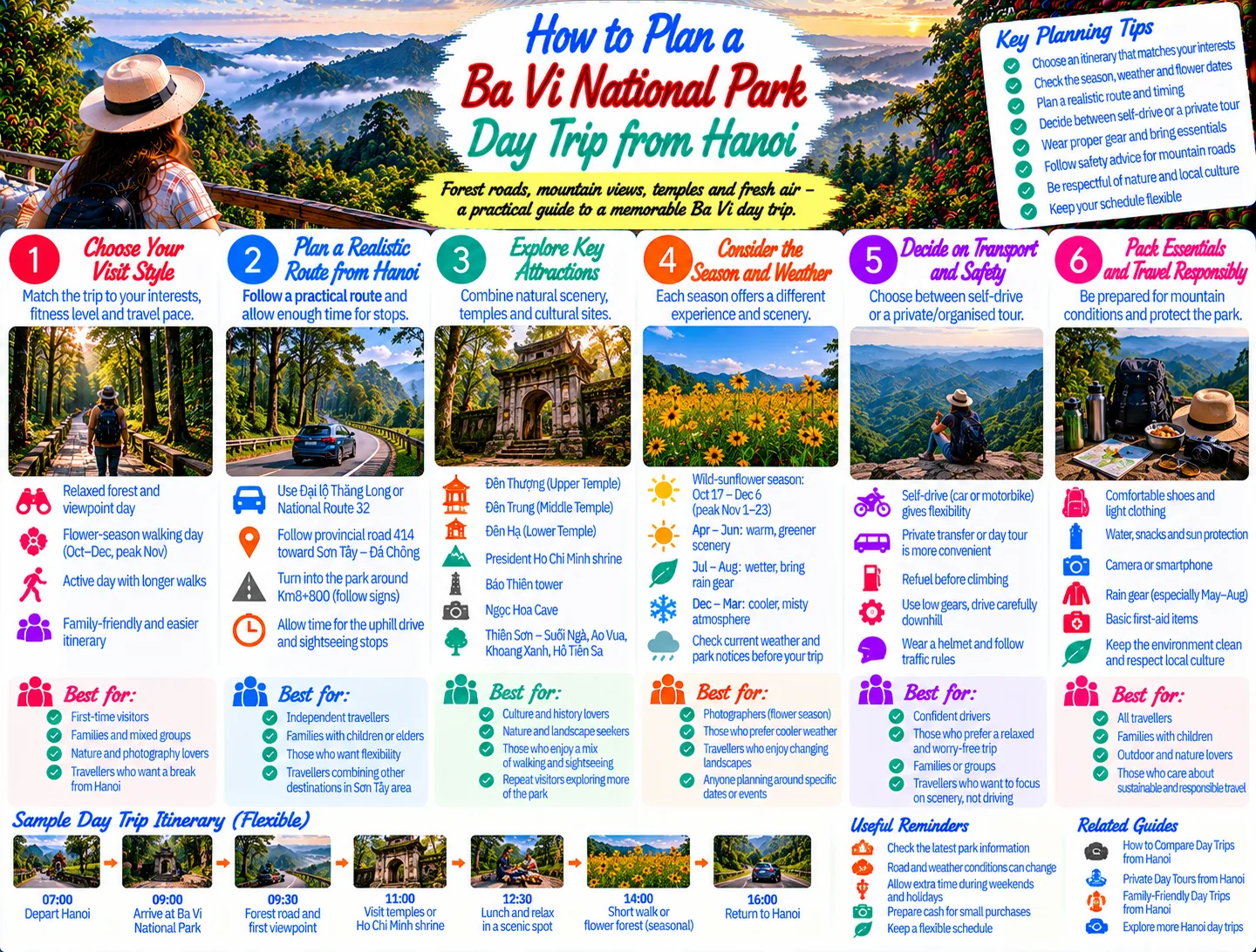
Option one: a relaxed scenic day
Leave Hanoi with enough time for an unhurried drive into the Ba Vi area. After entering the mountain landscape, make the uphill road and forest scenery the first experience rather than treating them as dead time. Stop where it is safe and permitted, stretch your legs, and allow space for weather changes.
Continue toward the higher visitor areas, choosing one or two principal walks instead of collecting every possible viewpoint. A relaxed day works well for couples, older travellers, and anyone who wants photographs and conversation more than a demanding hike. The return journey can include a countryside meal or a calm stop near the foothills if your driver or guide knows a suitable, open venue.
Option two: a more active mountain day
For a hiking-oriented Ba Vi trip, set an early start and keep the rest of the itinerary simple. Wear shoes with grip, carry water, and expect steps, slopes, roots, and damp surfaces after rain. Focus on the mountain sections that match your group’s ability; the goal is to enjoy the forest rather than prove how many kilometres can be covered.
Build in a real break before the descent. Going downhill can be tiring on knees and ankles, and a rushed return after a long walk is uncomfortable. If one traveller is less active, agree in advance on a meeting point or a shorter alternative so the group does not split without a plan.
Option three: Ba Vi plus a nearby countryside stop
A combined day can work when the second stop is close to the route and does not compete with the mountain experience. A village, local food stop, or short cultural visit may add variety, but avoid pairing Ba Vi with a distant headline attraction simply because it looks possible on a map. Travel time, weather, and the mountain road can make a nominally full itinerary feel exhausting.
Use the site’s Ba Vi Nature Trips category for related planning ideas, and compare the pace with the broader Hanoi Countryside Tours category before choosing a combination.
What to see and do in the park
The strongest reason to visit is the changing mountain environment. Lower roads and foothill areas feel more open, while higher sections bring denser vegetation, cooler air, and a greater sense of elevation. The exact appearance changes with season and weather, so do not plan around a single photograph or promise yourself a clear panorama.
Forest walks are the most dependable activity. They offer shade, birdsong, textured plants, and a slower rhythm than city sightseeing. Some paths and approach routes include many steps. Take them steadily, keep both hands free where possible, and avoid turning a short walk into a difficult climb by ignoring the surface underfoot.
Mountain viewpoints and summit-area landmarks can add a cultural dimension to the day. The Ho Chi Minh Temple on the King Peak is often associated with a long stair approach, making it important to consider fitness and heat before committing. Respectful clothing and quiet behaviour are appropriate at religious sites, even when they sit within a popular nature destination.
Ba Vi also has a colonial-era atmosphere in parts of the mountain landscape, including remnants that remind visitors that the area has a layered history. Treat ruins as fragile places: do not climb unstable structures, remove objects, or use historic walls as props for risky photographs.
When is the best time for a Ba Vi day trip?
Ba Vi can be visited in different seasons, but the best choice depends on what you want to do. Clear, dry conditions are more comfortable for walking and views. Cooler or misty weather can make the forest feel atmospheric, but it can also reduce visibility and make steps slippery. Rain may arrive quickly in the mountains, even when Hanoi looks bright.
Flower seasons are often part of Ba Vi’s appeal, particularly when visitors hope to see wildflowers on the slopes. Treat seasonal colour as a bonus rather than the only reason to travel, since bloom timing varies with weather and elevation. Check current local conditions shortly before leaving and keep the plan flexible.
Weekends and public holidays can feel busier, especially at popular approach roads and photo stops. A weekday departure is usually easier for travellers who value quiet. Whatever the date, start early enough to enjoy the mountain before fatigue and afternoon weather narrow your options.
Getting from Hanoi to Ba Vi
Private transport is the easiest option for a Ba Vi National Park day trip because it lets you carry water and extra layers, stop safely, and adjust the return time. A private car is especially useful for families or mixed-ability groups. If you are comparing transport styles, the practical decision framework in When a Private Day Tour Makes Sense is relevant here: flexibility is often more valuable than simply choosing the lowest headline price.
Independent travellers may use a combination of public transport and local transfers, but this requires more preparation. Check the final approach before setting out, because the last part of a mountain visit is not the same as travelling to a town centre. Confirm where you will meet your return transport and do not assume a vehicle will be immediately available at a remote stop.
Navigation apps can help with the broad direction, but signal, road conditions, and one-way access may affect the final route. Ask your driver or accommodation for current local advice rather than relying on an old blog post that lists fixed timings or prices. Those details change and should be verified close to the travel date.
What to pack for a Ba Vi hiking day
Pack for a changeable mountain environment, not just a warm Hanoi morning. A small day bag is easier to manage on steps and forest paths.
- comfortable shoes with a secure sole;
- water and a simple snack;
- light rain protection or a compact waterproof layer;
- sun protection for exposed roads and viewpoints;
- insect repellent if you are spending extended time in vegetation;
- a light extra layer for cooler or misty high areas;
- cash only if you have independently confirmed that a particular stop requires it.
Keep your phone protected from rain and bring a portable battery if you expect to use navigation and photography all day. Do not overpack food in single-use wrappers. A reusable bottle and a small bag for your rubbish make the visit easier on the park and on the people who maintain it.
Safety, etiquette, and responsible travel
Ba Vi is a natural environment with uneven surfaces, slopes, weather exposure, and roads that require attention. Stay on established paths where possible, follow signs and local instructions, and do not cross barriers for a better photograph. Children should remain close on steps and near drop-offs. If visibility falls in cloud or rain, shorten the route rather than trying to force the original plan.
Respect the mountain as both a protected landscape and a place with spiritual significance. Keep noise low near temples, dress appropriately for religious areas, and ask before photographing people. Leave plants, rocks, and historic remains where they are. Do not feed wildlife or leave scraps behind.
Good timing is also responsible travel. A realistic itinerary reduces the temptation to speed, crowd a narrow path, or pressure a driver to make an unsafe final stop. If your group is tired, a shorter visit is a successful visit. For families, the guidance in Choosing a Day Trip the Whole Family Can Enjoy can help you balance scenery with breaks and realistic walking expectations.
Common planning mistakes to avoid
- Trying to see everything: Ba Vi rewards depth and patience more than a long list of pins.
- Ignoring the climb: A map distance does not show steps, slopes, heat, or damp ground.
- Using city clothing and shoes: Sandals and smooth soles are poor choices for wet forest paths.
- Relying on old prices and opening hours: Verify current details directly before travelling.
- Leaving no weather buffer: Mountain conditions can change faster than a city forecast suggests.
- Assuming every road stop is safe: Pull over only where your driver confirms it is permitted and secure.
Is Ba Vi right for your Hanoi itinerary?
Choose Ba Vi when you want a flexible Hanoi nature trip with mountain scenery, forest walks, and room to slow down. It is a strong fit for travellers who prefer a landscape-led day and are comfortable adapting to weather and walking conditions. It is less suitable when you need guaranteed hourly sightseeing, fully flat access, or a packed list of unrelated attractions.
The best Ba Vi National Park itinerary is modest: one clear reason to go, a route that matches your group, enough time for rest, and a return plan that does not depend on perfect conditions. Plan the mountain as a living environment rather than a theme-park schedule, and the day becomes calmer, safer, and much more rewarding.
JOIN THE CONVERSATION
Comments (0)
No comments yet. Be the first to share a thought.