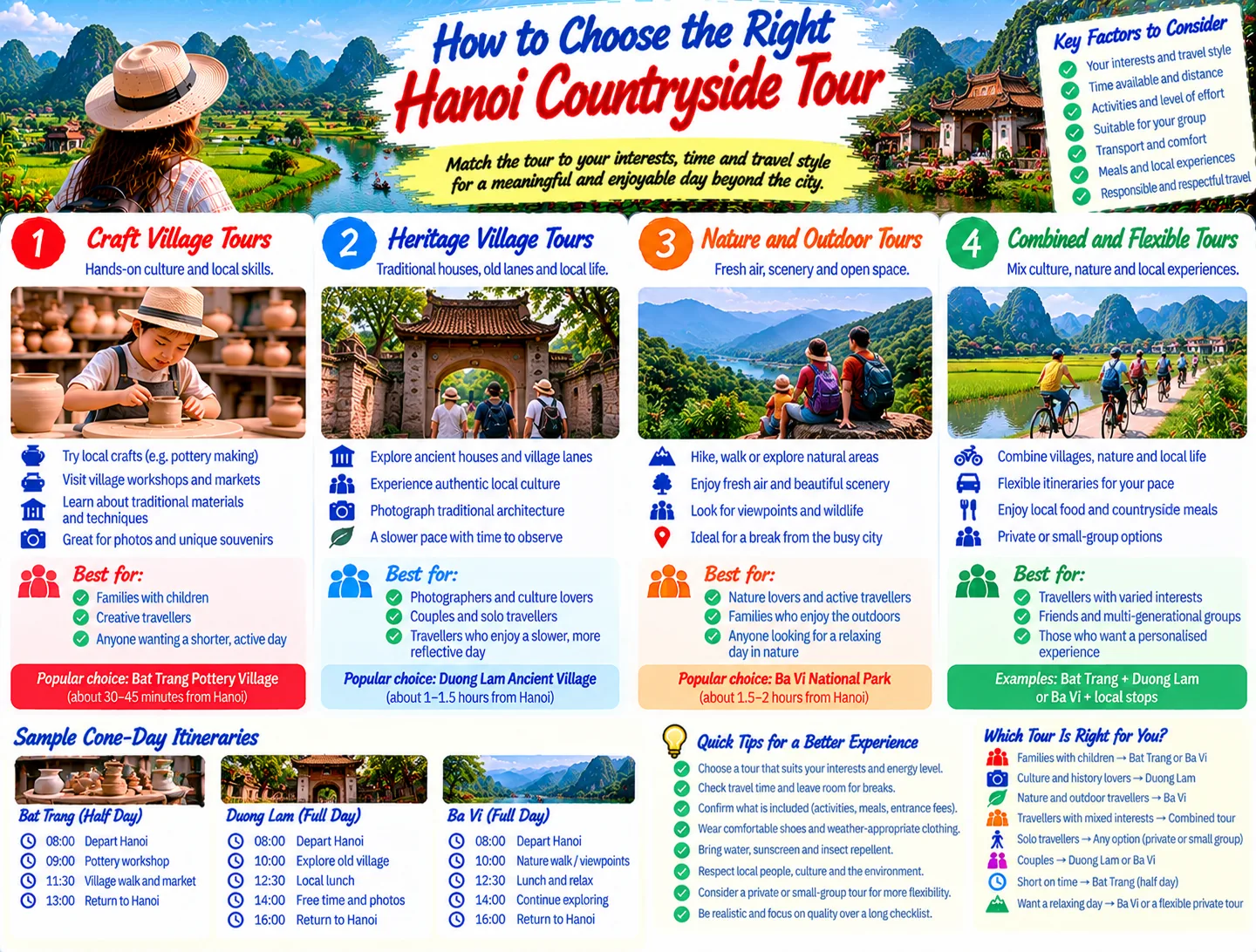
Hanoi is more than a launch point for famous landmarks. Beyond the city, rice fields, river villages, craft communities and wooded hills create a different kind of travel day. The challenge is choosing a Hanoi countryside tour that fits your pace rather than simply joining the longest itinerary. A family may want hands-on making, a photographer may prefer old lanes and quiet courtyards, while a nature lover may be happiest with open space and a flexible return.
This guide compares the main countryside styles around Hanoi and shows how to match them to your time, interests and comfort level. It also explains what to check before booking, so you can plan a rewarding day without relying on a crowded checklist of attractions.
Start with the experience you actually want
Searches for Hanoi countryside tours often produce similar-looking promises: local life, culture, nature and a chance to escape the city. Those phrases are useful, but they do not tell you how the day will feel. Begin by choosing your main experience, then use distance, transport and timing as filters.
Hands-on culture: choose a craft village where you can see materials, tools and finished work rather than only visiting a shop.
Living heritage: look for an old village with lanes, houses, communal spaces and a respectful approach to residents.
Nature and fresh air: prioritise a countryside route with room for walking, scenery and unhurried stops.
Easy family interest: favour an itinerary with one memorable activity and breaks, rather than many short photo stops.
Independent discovery: consider a private or small-group day if you want to adjust the pace or linger in one place.
For a wider framework, our guide to comparing day trips from Hanoi is useful before you narrow the choice to a countryside route.
Choose a craft village for an active cultural day
Craft villages suit travellers who want to do something, not just look at something. Bat Trang is the clearest example. Vietnam’s official tourism authority describes it as a long-standing pottery village on the Red River, with a history of more than 700 years. The same guide notes that visitors can walk through the village, see the Van Van ancient house, join a pottery workshop and browse the pottery market.
That combination makes Bat Trang a strong option for a first countryside outing. A workshop gives the day a simple narrative: learn the material, shape a piece, and understand why the finished object matters. The market and village streets then add time for browsing without requiring an ambitious sightseeing list. Families and creative travellers often appreciate this structure because the activity creates a shared memory even when ages or interests differ.
Allow enough time for the making experience and do not assume every item can be taken home immediately. Ask the operator how the piece will be dried, finished or collected before you begin. If this is your main interest, see the site’s separate guide to a half-day visit to Bat Trang Pottery Village, then browse the Bat Trang Village Trips category for related planning ideas.
When Bat Trang is the right match
You want a clear activity rather than a day built around long walks.
You enjoy buying useful or decorative handmade objects.
You are travelling with children or mixed interests and need an approachable focus.
You prefer a shorter countryside outing that can leave energy for an evening in Hanoi.
Choose a heritage village for atmosphere and slower observation
A heritage-focused route is less about completing attractions and more about noticing how a place is organised. Duong Lam is a natural fit for travellers drawn to old lanes, traditional architecture and the feeling of a lived-in village. The important planning point is to treat it as a community, not an open-air film set. Walk quietly, ask before photographing people or interiors, and buy or eat locally where appropriate.
This style of Hanoi countryside tour rewards patience. Instead of rushing between several distant stops, spend time looking at gateways, courtyards, trees, walls and everyday movement. A guide can add value by explaining what is private, what is communal and what has changed. Without that context, visitors may see an attractive old building but miss the social meaning of the space around it.
Duong Lam is especially suitable for photographers, architecture fans and travellers who prefer cultural texture to staged entertainment. It can also work for couples or solo visitors who want a reflective day. The trade-off is that the experience may feel quieter than a workshop or a major attraction. If your group needs constant activity, combine heritage with a carefully chosen meal or another nearby stop rather than adding a long list of unrelated sites.
Read visiting Duong Lam with care for a living heritage village before you go, and use the Duong Lam Ancient Village category to build a more considerate itinerary.
Choose a nature-led route when the city feels too busy
Nature-oriented Hanoi countryside tours are best for travellers whose priority is space rather than a particular monument. Ba Vi is the obvious planning direction on this site, but the right itinerary depends on the amount of walking, the weather and how much time you want to spend outdoors. A nature day should not be judged by the number of viewpoints or stops. It succeeds when you return feeling that the pace changed.
Before booking, ask what “nature tour” means in practice. It may involve a short forest walk, a scenic drive, a picnic-style stop, a longer hike or a combination of outdoor and cultural visits. Those are very different experiences. Confirm the walking surface, elevation, shade, footwear expectations and what happens if rain changes the plan. If the route includes a protected landscape or managed site, ask the operator which visitor rules apply rather than assuming a flexible countryside walk.
Nature routes are a good match for repeat visitors to Hanoi, couples, active travellers and anyone who finds craft markets or heritage lanes too urban in feel. They are less suitable when your group has limited mobility or when the forecast is uncertain and there is no indoor alternative. For a focused starting point, explore Ba Vi Nature Trips and compare the walking commitment with the rest of your travel week.
Match the route to your available time
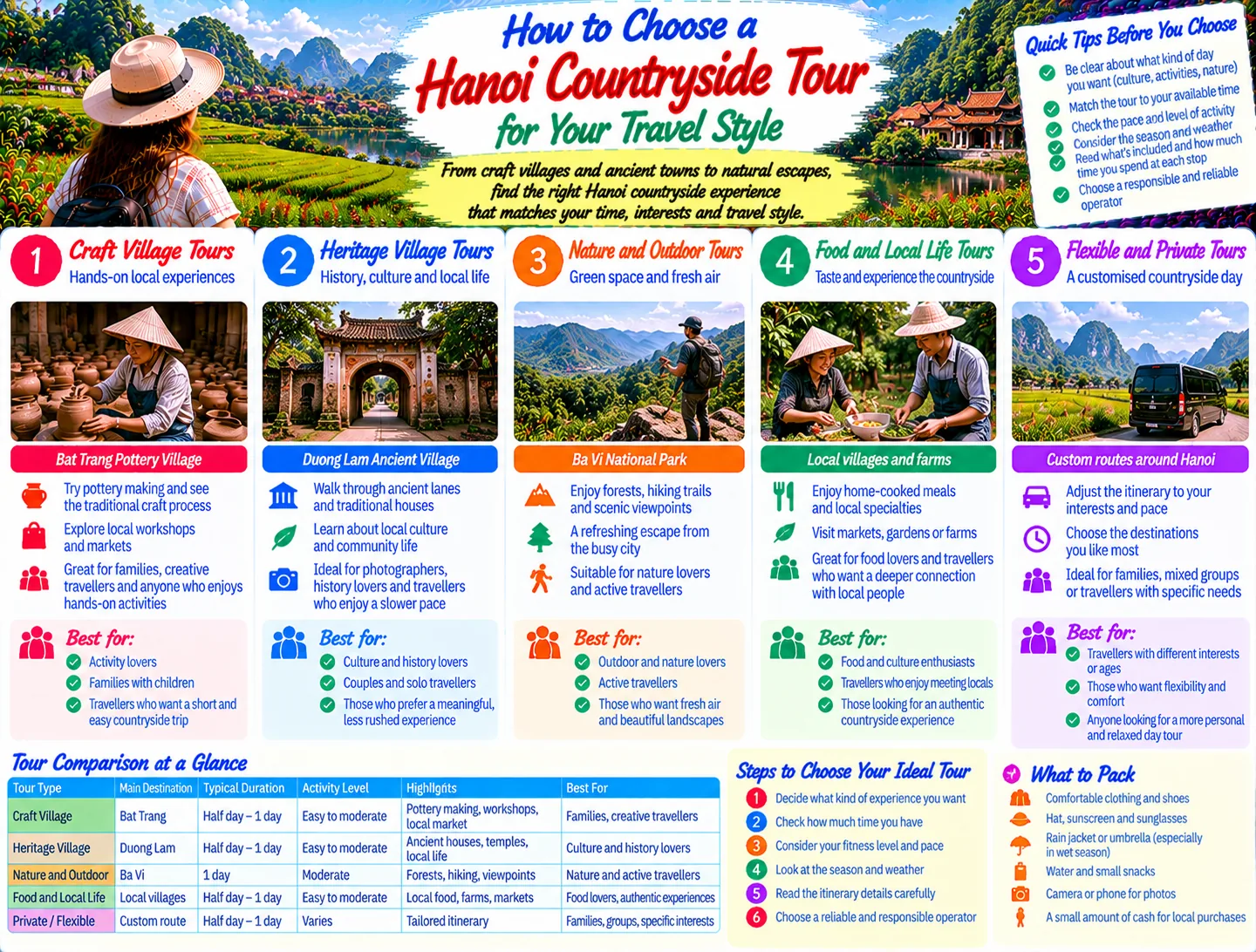
The best Hanoi countryside tour is not necessarily the one with the greatest distance. A half-day route can be the smarter choice after a late arrival, before an evening train, or during a trip that already includes several full-day excursions. It gives you one strong experience without turning every day into a transfer day.
A full day makes more sense when the destination itself is the point and you want room for walking, conversation and an unhurried meal. It also gives a guide more flexibility if traffic or a slower group changes the schedule. However, “full day” should not mean filling every hour. Ask how much time is spent travelling, how many stops are fixed, and whether the return time is an estimate rather than a guarantee.
A practical timing checklist
What is the planned departure window from Hanoi?
How much of the itinerary is transport compared with time at the destination?
Is the route designed around one anchor experience or several brief stops?
Can you leave a market, workshop or village when your group is ready?
What is the plan if rain, heat or traffic changes the order?
Use the existing article on an unhurried countryside escape from Hanoi for a slower approach, especially if your priority is atmosphere rather than maximising coverage.
Decide between group, small-group and private travel
Group tours can be efficient when you want a straightforward introduction and do not mind following a set rhythm. They may also make a craft activity or shared meal more social. The compromise is less control over photo stops, meals and departure timing.
Small-group trips usually offer a middle ground. You still have a defined plan, but conversation with the guide can be easier and adjustments may be more realistic. Private tours are most valuable when your group has a particular need: grandparents who need extra pauses, children who lose interest quickly, photographers who want time, or travellers who want to combine a village with a nature stop.
Do not choose private travel only because it sounds premium. Choose it when flexibility changes the quality of the day. Our guide to when a private day tour makes sense can help you decide whether that extra control is relevant to your group.
Check the details that shape the day
Once you know your preferred experience, evaluate the practical details in plain language. A reliable operator should be able to explain the meeting point, vehicle arrangement, walking level, inclusions, meal plan and cancellation or weather policy. If the description uses broad phrases such as “authentic local experience,” ask what you will actually do and how long you will spend there.
For craft villages, clarify whether a workshop is included or optional, whether materials are supplied, and how finished work is handled. For heritage villages, ask how the tour approaches private homes and photography. For nature routes, ask about footwear, shade, toilets, water and the fallback plan in poor weather. These questions are more useful than comparing a long list of promised stops.
Also check the return plan against your next commitment. Traffic around Hanoi can make an apparently comfortable schedule feel tight. Avoid booking a countryside tour immediately before a flight or important connection unless the operator gives you a realistic buffer and you understand the transfer responsibility.
Build a balanced countryside itinerary
If you have several days in Hanoi, resist the temptation to repeat the same kind of outing. Pair a hands-on craft day with a quieter heritage visit, or place a nature-led route after a busy city schedule. This creates contrast and helps you notice what you genuinely enjoy.
A simple three-day pattern could be one short craft-focused outing, one full day with more landscape or heritage, and one flexible city day. The order is less important than leaving recovery time. Countryside travel still involves early starts, road time and unfamiliar walking surfaces, so a realistic itinerary will feel richer than an ambitious one that leaves everyone tired.
Think of each route as a relationship between place and pace. Bat Trang gives you a tangible activity and a strong craft identity. Duong Lam rewards observation and respect. Ba Vi suits open-air time and a change of scenery. The right choice is the one whose rhythm matches your travellers.
Conclusion: choose the day you want to remember
Planning Hanoi countryside tours becomes easier when you stop comparing destinations only by fame or distance. Choose Bat Trang for making and browsing, Duong Lam for living heritage and atmosphere, or a Ba Vi route when nature and space matter most. Then match the route to your available time, walking comfort and need for flexibility.
A well-chosen day trip does not try to show you everything outside Hanoi. It gives you one clear experience, enough time to appreciate it, and a return journey that leaves room for the rest of your Vietnam trip.
JOIN THE CONVERSATION
Comments (0)
No comments yet. Be the first to share a thought.