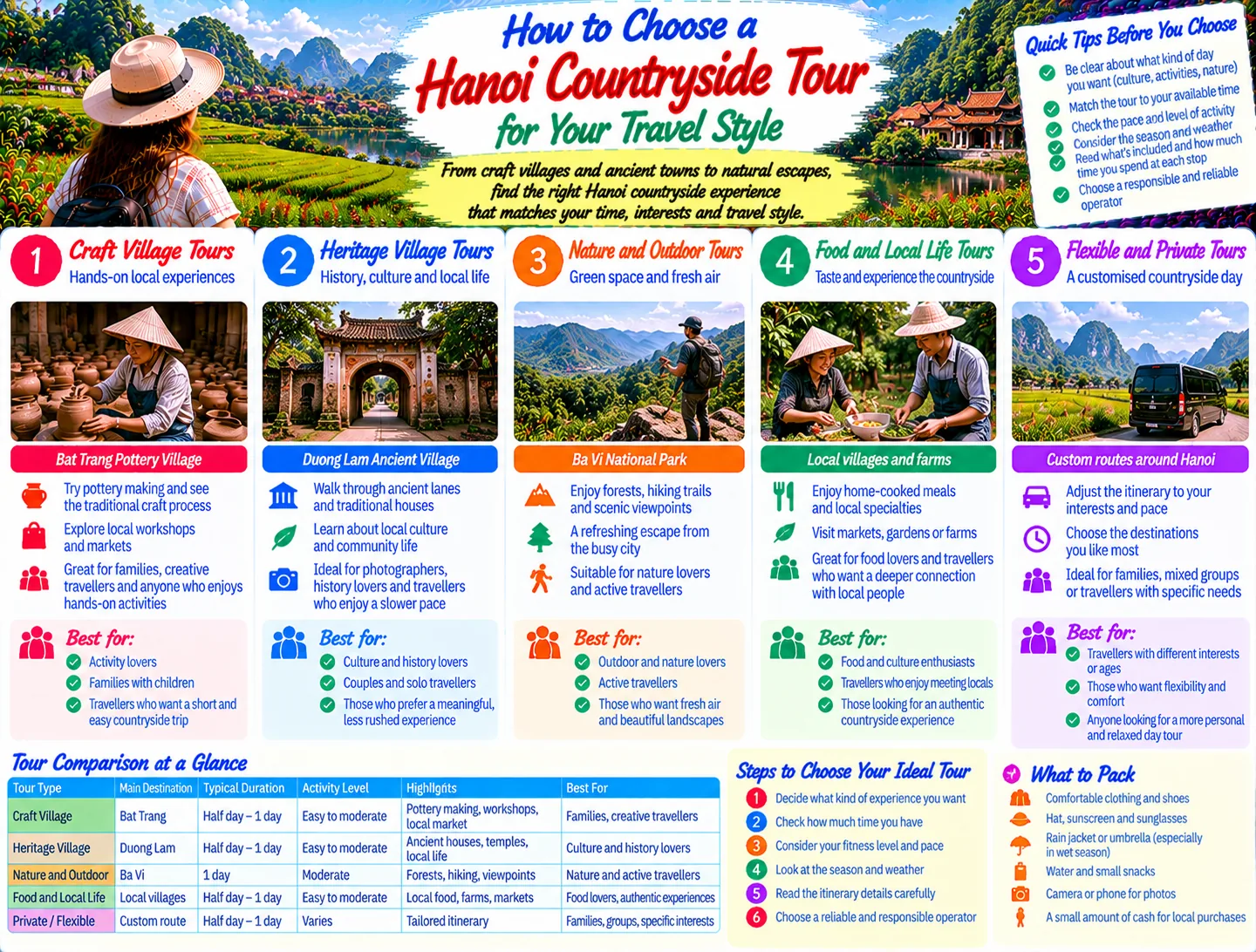
A Hanoi countryside tour can mean a quiet village morning, a hands-on craft experience, a forested escape, or a full day built around heritage and local food. The best choice is not simply the destination with the most famous name. It is the route that matches your available time, preferred pace, mobility, weather tolerance, and interest in meeting people rather than collecting viewpoints. This guide gives you a practical way to choose among the countryside experiences around Hanoi without trying to force every place into one itinerary.
Start with the kind of day you want
Before comparing operators or transport options, describe the day in one sentence. Do you want to make something with your hands, walk through an old settlement, spend time outdoors, or combine several small experiences? That answer is more useful than starting with a destination list.
For culture and living heritage
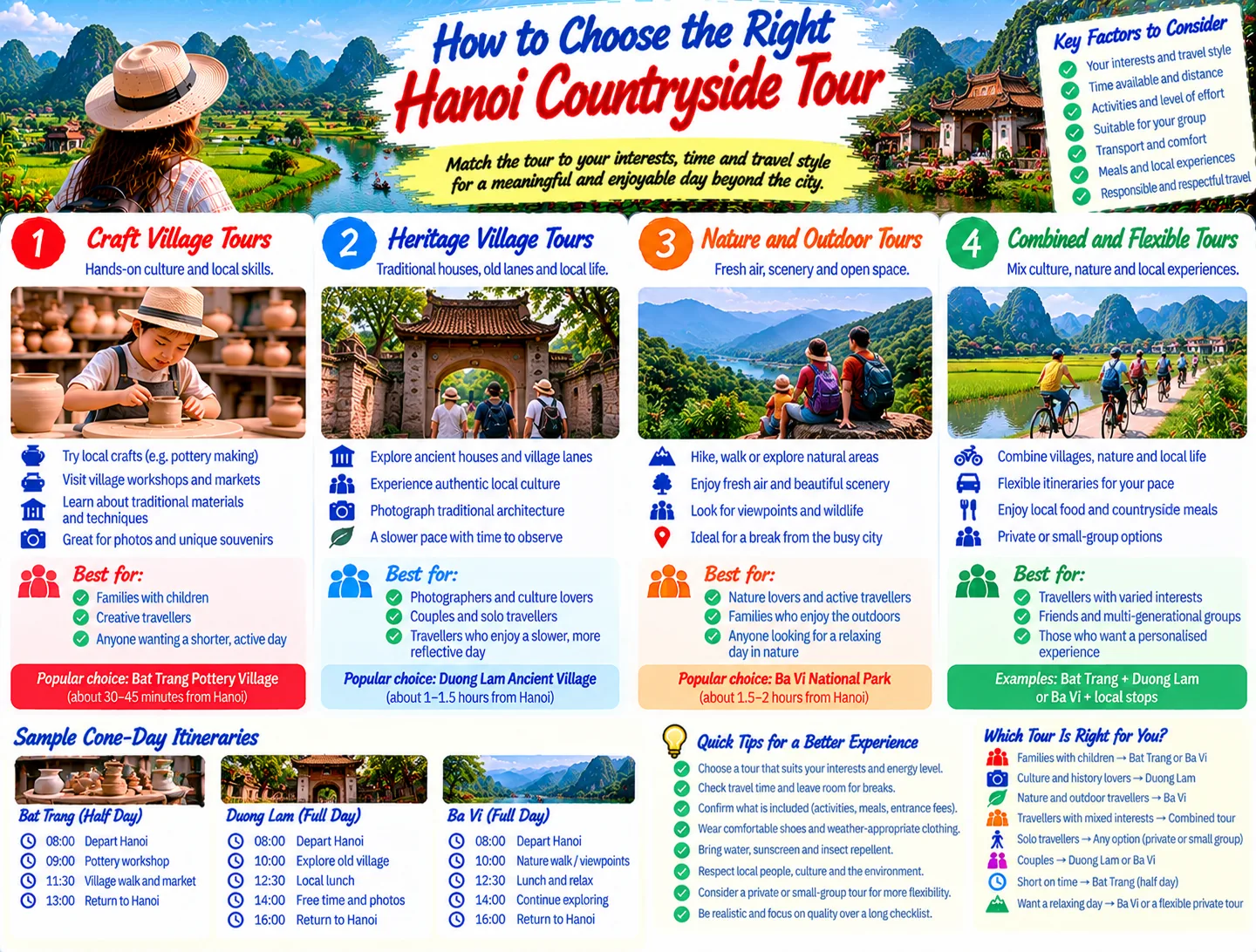
Choose a village-focused route when you want architecture, household traditions, local food, and conversations with residents. Duong Lam is a strong fit for travellers who prefer a slower heritage day: the interest is in moving through a living village, noticing the relationship between lanes, houses, temples, gardens, and everyday life. It rewards curiosity more than speed. If this is your priority, our guide to visiting Duong Lam with care for a living heritage village is a useful companion.
For making and learning
Choose a craft-village tour when the activity matters as much as the sightseeing. Bat Trang works well for travellers who enjoy pottery, demonstrations, browsing finished work, and the possibility of making something themselves. The experience is naturally more interactive than a viewpoint stop, but it can also be more dependent on the exact workshop or host included in the itinerary. Read our half-day guide to Bat Trang Pottery Village before deciding whether a short visit is enough.
For green space and open air
A nature-led day around Ba Vi suits travellers who want trees, fresh air, and a break from dense city streets. It is a better match for people who are happy to spend part of the day outdoors and accept that a nature itinerary may feel less tightly scheduled than a museum-to-museum route. Compare it with the practical suggestions in Ba Vi nature trips if your priority is landscape rather than village detail.
Match the route to your available time
Time is not just a scheduling problem. It changes what kind of countryside experience will feel satisfying. A route that looks excellent on a map can become tiring when every stop is rushed.
Half a day
For a half-day, choose one main area and one clear purpose. Bat Trang is often easier to understand as a compact craft-focused outing, while a nearby village route can work when you want a small change of scene without turning the day into a checklist. Avoid combining a distant nature area with several heritage stops in a short window. You will spend the day watching the clock and leave with shallow impressions of each place.
One comfortable day
A full day gives you room for a substantial morning stop, a relaxed meal, and a second experience that complements rather than repeats the first. For example, a heritage-focused route can add a local food or craft element, while a nature-focused route can include a village or cultural stop if the logistics are confirmed. Leave space for traffic, weather, finding the meeting point, and the ordinary pauses that make a countryside day feel different from an urban tour.
A flexible private itinerary
If your group includes different ages or energy levels, a private day tour may be worth considering because the route can be shaped around your priorities. The article When a Private Day Tour Makes Sense explains the trade-off: flexibility can be valuable, but it does not automatically make a long list of stops realistic. Ask the operator how much time is protected at the main destination, not only how many places appear in the description.
Choose by pace, not only by distance
Two countryside tours can take a similar amount of time and still feel completely different. One may involve a guide-led walk, repeated vehicle changes, and several short stops. Another may spend most of the day in one community with time to observe, eat, and ask questions.
Slow and observant: choose one village or nature area, with time for walking and unplanned conversation.
Activity-led: prioritize a workshop, cooking session, cycling segment, or other clearly described participation.
Photographic: ask whether the route allows enough time at the places you want to photograph instead of promising many locations.
Efficient overview: accept shorter stops, but confirm which experiences are viewing-only and which include time inside a venue or village.
Read the wording carefully. “Visit,” “pass by,” “photo stop,” and “experience” do not necessarily describe the same amount of time on the ground. A good itinerary makes the rhythm visible: departure, principal stop, meal, secondary stop, and return. If those details are missing, ask before booking rather than assuming the most generous interpretation.
Consider weather and the season
Hanoi’s countryside is not one uniform experience throughout the year. Heat, humidity, rain, and visibility can change how enjoyable walking, cycling, forest trails, or open-air village visits feel. You do not need a perfect forecast to choose well; you need a route whose main appeal still works if conditions are less than ideal.
In warmer or wetter conditions, favour itineraries with shade, indoor craft spaces, flexible stops, and a realistic plan for breaks. In cooler, clearer periods, a longer walking route or nature day may feel more rewarding. Treat “best season” language as a prompt to compare your own comfort with the tour’s demands, not as a rule that invalidates every other month.
Events can also influence the atmosphere. The official Vietnam Tourism listing for Hanoi Autumn Festival 2026 describes a September cultural-tourism programme built around heritage spaces, performances, and traditional cuisine. Its dates are specific to 2026, so use such listings as time-sensitive planning information rather than an evergreen promise. The same principle applies to the Hanoi Craft Village Tourism & Gastronomy Festival 2026, listed for October 1–31, 2026: it shows how craft villages can become part of a wider seasonal programme, but it does not mean every workshop or village has the same event schedule.
Decide how much local interaction you want
“Authentic” is often used too broadly in tour descriptions. A more useful question is how you want to interact with a place. Do you want a guide to explain context while you observe? Do you want to learn a craft? Are you comfortable entering a working home, workshop, or religious site only when invited and with clear etiquette?
Look for specific activities
Strong descriptions name the activity and its setting: a pottery session, a guided village walk, a conversation with an artisan, a meal hosted by a local family, or time in a particular landscape. Vague claims about “real local life” are less helpful than a clear explanation of what guests actually do.
Travel respectfully
In a living village, people are not scenery. Follow your guide’s advice about photography, ask before entering private or working spaces, and avoid interrupting residents to create a better picture. If a route includes a religious or heritage site, ask about suitable clothing and behaviour in advance. These small choices improve the experience for both visitors and hosts.
Check the practical details before booking
Once you know your preferred style, compare tours using the same questions. This prevents a low headline price or a long destination list from deciding for you.
Where is the exact pickup point, and is hotel pickup included or limited?
How much time is spent travelling compared with time at the main destination?
Is the route suitable for your group’s walking ability, and are there uneven paths, stairs, or outdoor sections?
What is included for meals, workshop fees, entrance fees, and drinks?
What happens if heavy rain changes an outdoor activity?
Is the group size fixed, and how much time is reserved for questions?
Can dietary needs, child requirements, or slower pacing be discussed before departure?
Be especially careful with details that change: prices, opening hours, transport arrangements, workshop availability, and event dates. Confirm them with the operator shortly before travelling. A thoughtful tour description can explain the experience, but only a current confirmation can establish what is operating on your date.
Build a simple decision guide for your group
If you are travelling with other people, give each person one priority and look for the overlap. A couple may combine a heritage village with a food-focused stop. A family may prefer a shorter transfer, a hands-on activity, and a route with easy breaks. Friends with different interests can choose a private format or select one central experience rather than trying to satisfy everyone with six rushed stops.
For a broader framework, see How to Compare Day Trips from Hanoi. It is useful for weighing travel time, activity, scenery, and comfort across different destinations. You can also browse the Duong Lam ancient village trips category when your group is leaning toward heritage and local atmosphere, or compare the broader Hanoi countryside tours category when you are still deciding between styles.
Make the final choice with one clear promise
Before booking, complete this sentence: “By the end of the day, we want to have…” The answer might be a better understanding of village life, a piece of pottery, time in nature, a memorable meal, or simply a calm change of pace from Hanoi. Choose the itinerary that protects that promise instead of the one with the longest list of inclusions.
A well-chosen Hanoi countryside tour is not defined by how many kilometres it covers. It gives your group enough time to notice where you are, explains what makes the place meaningful, and leaves practical room for weather, traffic, meals, and human conversation. Match the destination to your interests, confirm the details that can change, and let one strong countryside experience be enough.
The simplest test is whether the itinerary still sounds appealing after you remove its marketing language. If the remaining plan has one clear reason to go, a realistic rhythm, and details your group can manage, it is probably a better fit than a busier alternative. Countryside travel is most rewarding when the schedule supports attention rather than competing with it.
JOIN THE CONVERSATION
Comments (0)
No comments yet. Be the first to share a thought.